The Region That Feeds a Nation Is Now Shaping Its Own Future
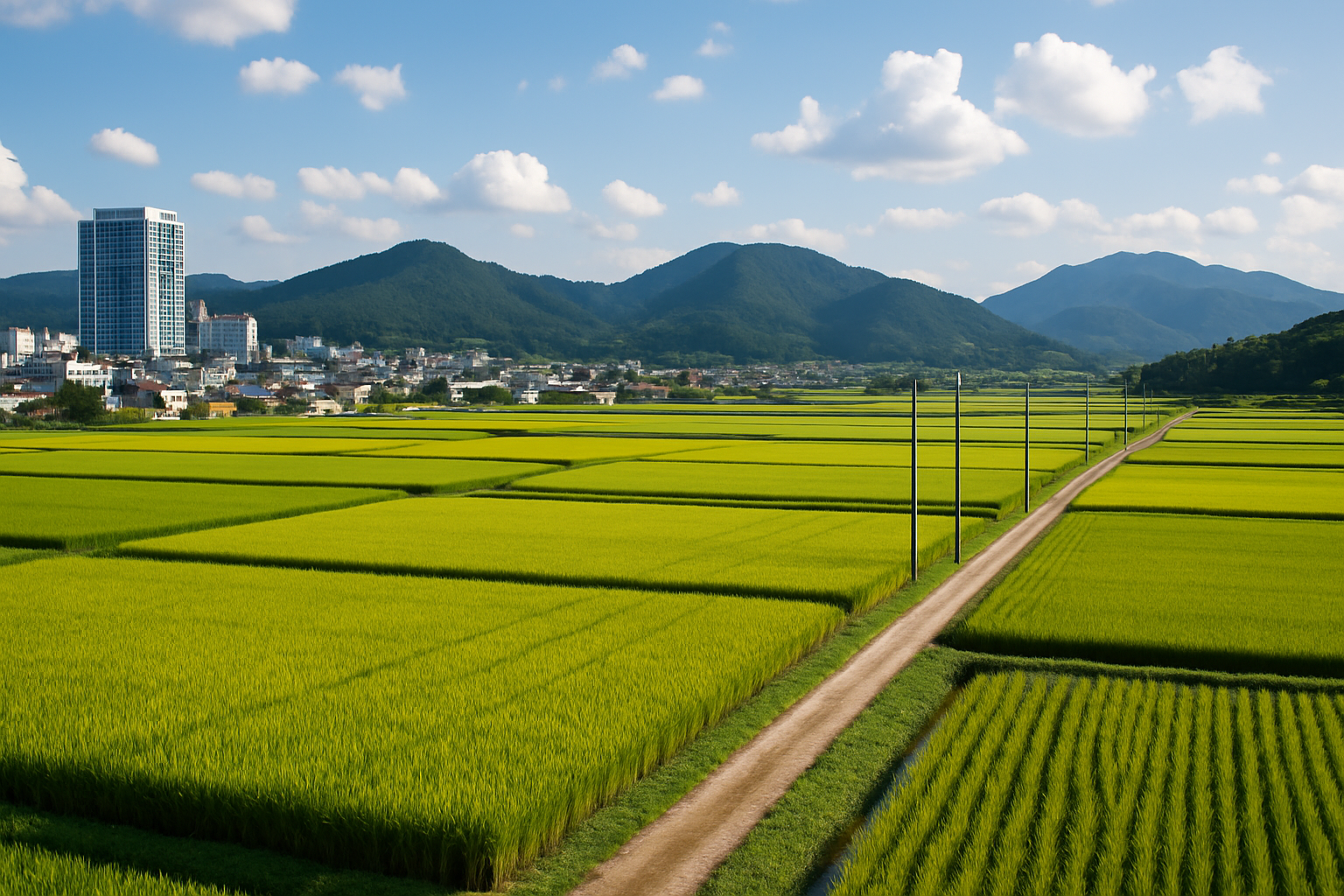
So here's the thing about North Jeolla Province — known in Korean as Jeollabuk-do, or more recently rebranded as Jeonbuk Special Autonomous Province — it isn't just a farming region. It's the place South Korea calls its agricultural capital. And right now, it's the center of a fascinating collision between local politics, national policy, and the future of Korean food and farming.
Between a heated gubernatorial race, a major push to attract national agricultural institutions, and a sitting president defending one of his signature rural policies, Jeonbuk has become a genuinely interesting window into where South Korea's agriculture is headed.
The Race to Become Korea's Agri-Bio Hub
Let's start with what the provincial government itself is doing. Jeonbuk officials have made it clear they're going all-in on attracting major public institutions in the agricultural and life sciences sector. At the top of their wish list: the National Agricultural Cooperative Federation (known in Korea as Nonghyup Junganghoe), the Korea Racing Authority, and the Agricultural Policy Insurance and Finance Service.
What's really interesting is the logic behind this push. Jeonbuk already has some serious infrastructure in place — the National Food Cluster, the Rural Development Administration, and the Korea Food Research Institute are all based in or near the region. The idea is to layer financial, research, distribution, and safety management functions on top of that existing foundation, turning the province into a true national hub for agri-bio industries.
If these institutions relocate, provincial officials argue, Jeonbuk could become competitive across the entire agricultural value chain — from smart farming technology to K-Food exports to food safety regulation. It's an ambitious vision, and one that's very much in play as the region prepares for its next chapter of leadership.
The Governor's Race: Farming Votes Are Up for Grabs
That brings us to the election. The Jeonbuk Special Autonomous Province gubernatorial race is heating up, and agricultural policy has emerged as the central battleground. That might seem unusual to international observers — but remember, agriculture isn't a side issue here. It's the backbone of the regional economy and a key reason people choose to stay or leave.
This is also the first major local election since President Lee Jae-myung took office, which means candidates have to navigate carefully between local needs and the central government's agricultural agenda.
Three candidates are leading the conversation, each with a distinct vision.
Lee Won-taek: Invest in Young Farmers, Protect the Vulnerable
Lee Won-taek, the Democratic Party candidate and a former member of the National Assembly's Agriculture, Food, Rural Affairs, Oceans and Fisheries Committee, is running on the platform of "Jeonbuk as the Agricultural Life Industry Capital." His approach is probably the most people-centered of the three frontrunners.
His standout pledge is expanding support for successor farmers and young agricultural workers — lowering the barrier to entry by increasing settlement grants and providing customized farmland support. For a sector grappling with an aging workforce, getting young people rooted in rural communities is arguably the most critical long-term challenge.
Lee also wants to strengthen a safety net for farmers when crop prices collapse, covering at minimum the cost of production. He's proposing to expand the rural resident allowance — a direct payment recognizing the public value of farming — and accelerate the transition to a data-driven smart agriculture system to handle increasingly unpredictable weather patterns.
On the industrial side, he envisions a "K-Food Innovation Belt" linked to the National Food Cluster, along with incubating food-bio venture companies and expanding local food distribution networks into livestock and fisheries. He's also pushing hard for village-level renewable energy income sharing — the so-called "Sunshine Income Village" model — as a way to diversify rural income beyond traditional farming.
Kim Kwan-young: Saemangeum as the Future of Korean Agriculture
The incumbent governor, Kim Kwan-young, is running as an independent and leaning into his track record. His flagship agricultural vision centers on Saemangeum — a massive reclaimed land area on Jeonbuk's western coast that has long been a subject of ambitious, if sometimes controversial, development plans.
Kim wants to turn Saemangeum into an AI-powered giant smart farm complex, a K-Food export hub, and the site of a second phase for the National Food Cluster. He's also proposing a seed industry innovation cluster, a national food museum, and a broader food-tech ecosystem — essentially repositioning Jeonbuk's agriculture not as a primary industry, but as a high-value food and biotech sector.
His approach is distinctly industrial in character. Critics might say it risks losing sight of individual farmers' day-to-day struggles, but supporters argue it's exactly the kind of structural transformation that will keep Jeonbuk competitive in the decades ahead. On the rural basic income question — a signature Lee Jae-myung policy — Kim is notably cautious, preferring a pilot program approach to verify effectiveness before scaling up.
Yang Jeong-mu: Back to Basics — Survival First
Yang Jeong-mu, the People Power Party candidate, is framing his campaign around what he calls the "survival crisis" of rural communities. His pitch is less about grand industrial transformation and more about addressing the immediate, compounding pressures farmers face: rising production costs, population decline, limited market access, and an aging demographic.
Yang's priorities include expanding sales channels for agricultural and fisheries products, reviving rural populations through young farmer and return-to-rural programs, and improving basic services — transportation and healthcare — in remote areas. It's a more grounded, welfare-oriented approach, and one that resonates with farmers who feel left behind by big-picture policy visions.
President Lee Defends the Rural Basic Income Program
Meanwhile, in Seoul, President Lee Jae-myung was busy defending one of his government's most talked-about rural policies. At a cabinet meeting marking his administration's first year in office, Lee addressed growing frustration from residents in rural townships (called "myeon" in Korean — essentially the smallest administrative unit in rural areas) who want the rural basic income program's spending restrictions loosened.
The rural basic income pilot program provides direct payments to residents of designated rural areas, but with a catch: the money can only be spent locally, within the community. Some residents find this inconvenient and have been pushing to use it in nearby cities.
Lee pushed back firmly.
"This program was designed to revitalize local communities precisely by asking residents to endure the inconvenience. If we allow spending in city centers, there's no longer any reason for new shops to open in the village or for people to move in."
The numbers, at least at this early stage, seem to support his argument. Agriculture Minister Song Mi-ryeong reported that in the pilot areas, population has grown by 4.7 percent, with 43 percent of new residents coming from the Seoul metropolitan area and other major cities. Some 80 percent of the basic income funds are already being spent locally, and 437 new businesses have opened in rural townships since the program launched.
The cabinet meeting also covered K-Food export performance — which hit a record high last year, with agri-food sector exports reaching 13.6 billion dollars — as well as expanded food support programs for pregnant women and children.
On the fisheries side, Minister Hwang Jong-woo of the Ministry of Oceans and Fisheries highlighted that seafood exports rose 9.7 percent year-on-year to a record 3.33 billion dollars. In a notable milestone, dried seaweed (gim, often called "Korean nori") became South Korea's second-largest food export after instant noodles — the first time in 15 years that any food product has challenged ramen's dominance in the export rankings.
What It All Adds Up To
Taken together, what's happening in Jeonbuk right now is a microcosm of the broader questions South Korea is wrestling with about the countryside. How do you modernize agriculture without hollowing out the people and communities at its core? How do you attract young farmers when urban life is so much more convenient? And how much of the solution comes from industrial transformation versus basic income support versus just making rural life more livable?
There are no easy answers — and honestly, the fact that three candidates with genuinely different visions are competing for votes in a region that takes farming seriously is, in itself, a good sign. The debate is real, the stakes are high, and Jeonbuk's next governor will have a significant hand in shaping what Korean agriculture looks like for the next generation.
This article is based on reports from Naver News, Agrinet, Agrinet.