The Most Talked-About Tech CEO Is Heading to Seoul
So here is the thing about Jensen Huang right now — wherever he goes, the cameras follow. The CEO of Nvidia, the U.S. chip giant that has become arguably the most important company in the global AI race, touched down in Taipei this week for GTC Taipei, and while he was there, he sat down with South Korean reporters and gave them a lot to work with ahead of his imminent visit to Seoul.
Huang confirmed that he would be arriving in South Korea as early as Thursday night, June 1, with a packed schedule of high-level meetings set for Friday. And if you thought the agenda would be limited to the usual semiconductor partnership talk, think again. Robotics is now very much on the table.
Robotics: The New Frontier in the Korea-Nvidia Conversation
When asked directly whether Nvidia is considering investments in South Korea, Huang did not hesitate. He said South Korea is always under consideration, pointing to the country's excellent infrastructure and business ecosystem. But what really stood out was when he singled out robotics as a specific area of interest.
"I think robotics is an important sector for South Korea, and Nvidia hopes to contribute to its development in the country."
What's really interesting is the reasoning behind that. Huang highlighted that South Korea is facing a shrinking workforce — a well-documented demographic challenge — but argued that the country's creativity and imagination make it uniquely positioned to leverage AI and robotics to fill that gap. It is a compelling pitch, and it signals that the conversation between Nvidia and Korea's tech giants is evolving well beyond memory chips.
Industry observers have been flagging this shift for a while now. The term gaining traction is "physical AI" — essentially, the integration of artificial intelligence into real-world machines and systems. Think robotics, autonomous vehicles, and smart manufacturing. South Korea, home to Hyundai, Samsung, and a dense network of manufacturers, is a natural fit for that vision.
Who's at the Table in Seoul?
According to industry sources, the guest list for Huang's Seoul meetings reads like a who's who of Korean corporate leadership. Expected attendees include Chey Tae-won, chairman of SK Group (the conglomerate behind SK Hynix, one of the world's leading memory chip makers), Koo Kwang-mo, chairman of LG Group, and Lee Hae-jin, the founder and board chair of Naver — South Korea's dominant search and tech platform. Hyundai Motor Group Executive Chair Euisun Chung is also said to be positively considering joining.
Notably absent from the expected lineup is Samsung Electronics Chairman Lee Jae-yong, who is reportedly overseas. That is a significant gap given Samsung's central role in the global chip supply chain, but it does not diminish the weight of the other meetings.
Huang himself, in classic fashion, played coy about the specifics. When pressed on who he would be meeting, he simply said what mattered most was that he would be eating fried chicken and samgyeopsal — the beloved Korean grilled pork belly. It got a laugh, but it was also a deliberate nod to his now-famous October visit to Seoul, when he joined Samsung's Lee Jae-yong and Hyundai's Euisun Chung for a late-night spread of chimaek — fried chicken and beer — that became one of the most talked-about moments in Korean tech culture that year.
The SK Hynix Connection
Before landing in Seoul, Huang made time for a private meeting in Taipei with Chey Tae-won of SK Group. SK Hynix posted photos from the encounter on its official Instagram, captioning it: "At GTC Taipei, SK Group Chairman Chey Tae-won and Nvidia CEO Jensen Huang drew the next picture of AI infrastructure together."
That framing — "drawing the next picture together" — is deliberate and telling. SK Hynix is the world's leading producer of High Bandwidth Memory, or HBM, the specialized chips that power Nvidia's most advanced AI processors. The two companies are deeply intertwined, and Huang acknowledged as much when speaking to reporters, saying Nvidia works "very closely" with SK Hynix and that he is "really proud" of the company's success — SK Hynix recently crossed the one-trillion-dollar market cap milestone, a remarkable achievement for a Korean chipmaker.
Also present at the Taipei gathering were Kwak Noh-jung, CEO of SK Hynix, Kim Jae-jun, executive vice president of Samsung Electronics' memory division, Jeong Su-heon, vice president of LG Science Park, and Kim Yu-won, CEO of Naver Cloud — making it a remarkably dense gathering of Korean tech leadership on neutral ground.
A Potential Stop at Naver 1784
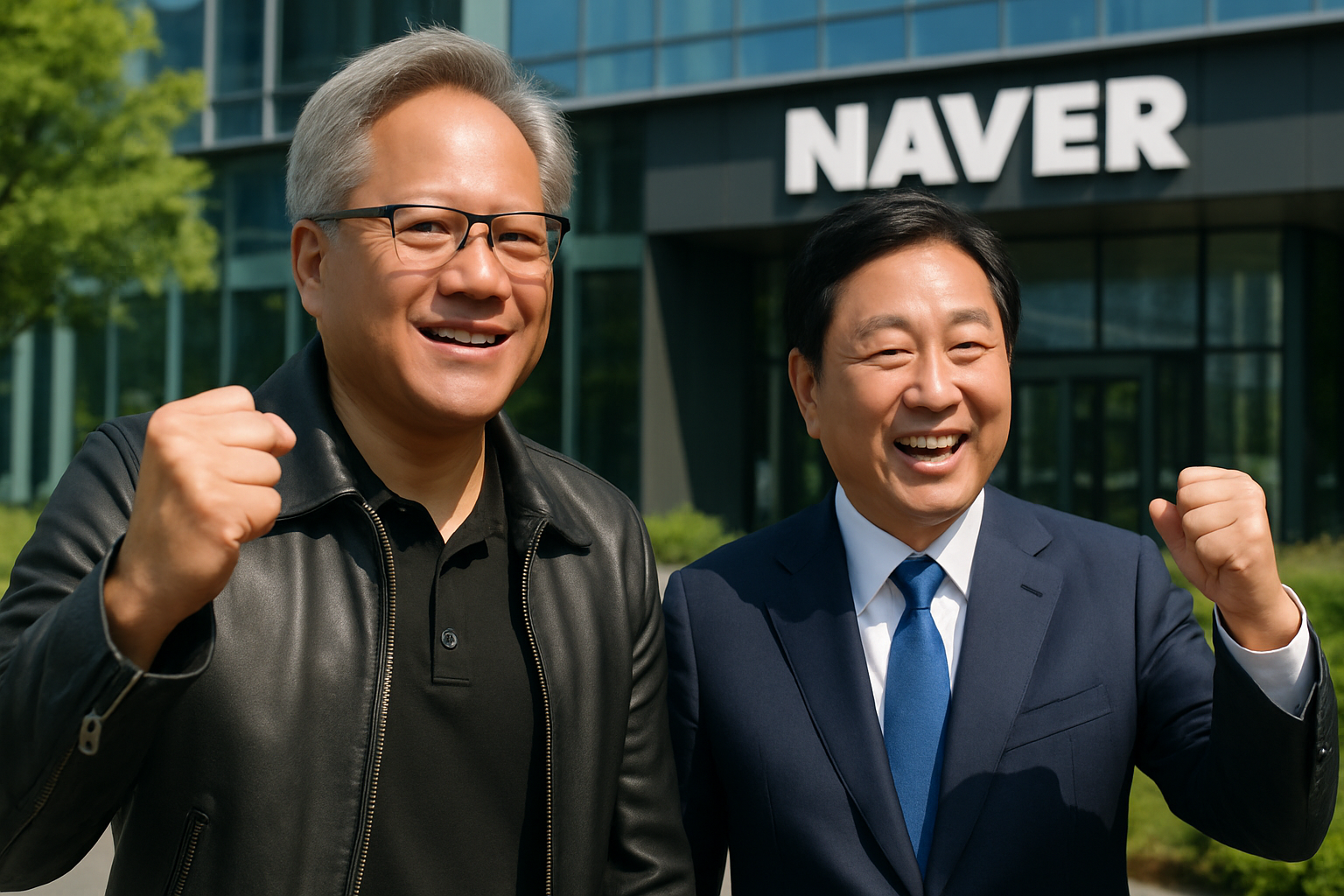
One of the more intriguing items on the rumored itinerary is a possible visit to Naver 1784, Naver's futuristic second headquarters building in Gyeonggi Province, just south of Seoul. The 28-story tower is not just an office — it is essentially a living laboratory for Naver's cutting-edge technologies, including service robots, cloud infrastructure, and 5G network systems.
For context, AMD CEO Lisa Su visited the same building back in March and signed a memorandum of understanding with Naver on AI infrastructure partnerships. If Huang follows suit, it would further cement Naver 1784 as a kind of pilgrimage site for the global AI industry's top executives.
And Then There Is the GTC Question
Huang also dropped a notable offer during his Taipei press remarks: he said he would bring Nvidia GTC — the company's flagship annual conference on AI and emerging technologies — to South Korea, if the country wants it. GTC has historically been held in San Jose, California, and has expanded to select international locations. Getting it to Seoul would be a significant symbolic and economic win for Korea's tech ambitions.
Whether that offer materializes into something concrete remains to be seen, but it reflects just how seriously Nvidia is taking South Korea as a strategic partner in the next phase of AI development. The conversations this week in Taipei, and the ones to come in Seoul, could shape the direction of that partnership for years.
This article is based on reports from Thefirstmedia, Inews24, Yonhap News.