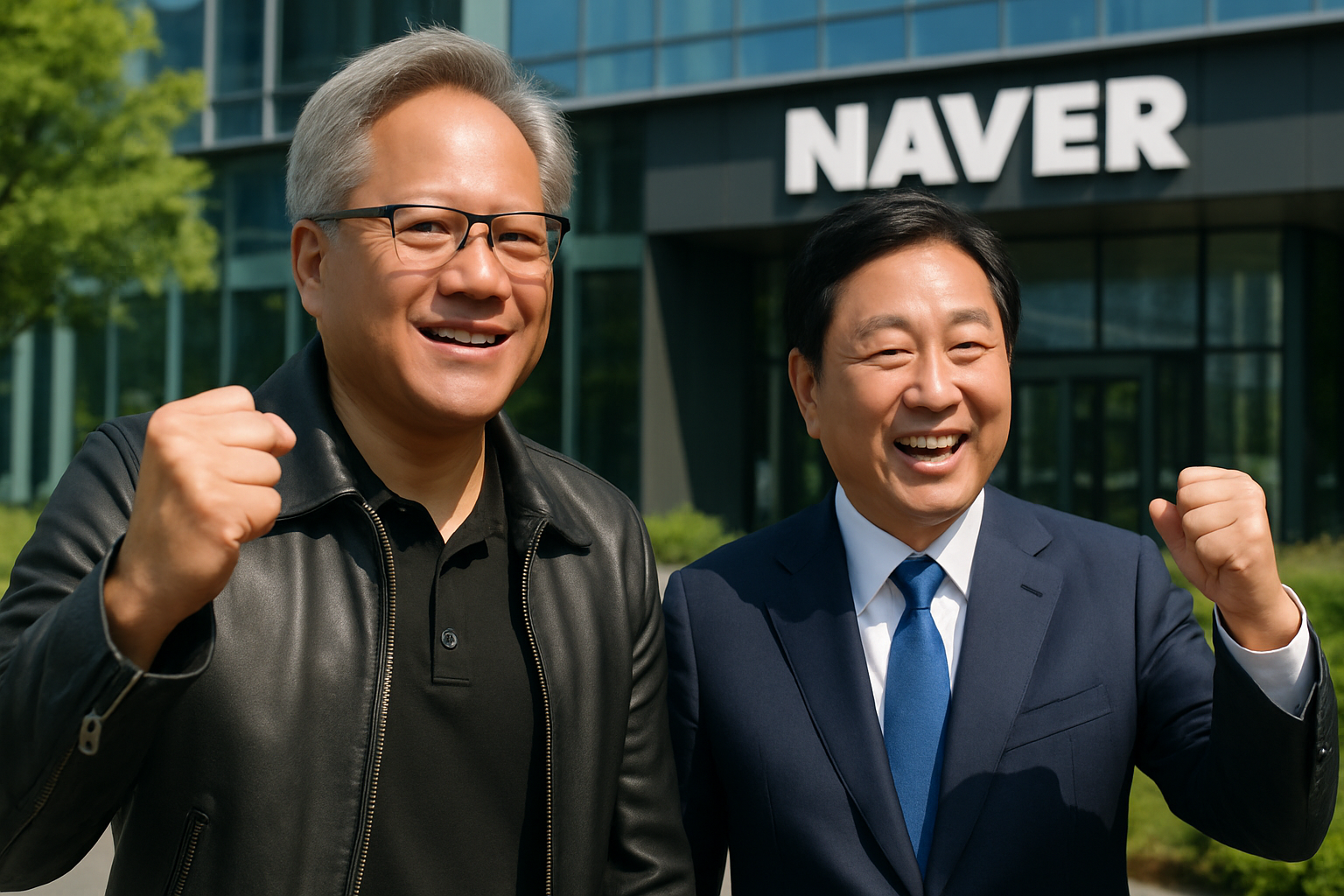
A Moment That Felt More Like a Pep Rally Than a Press Conference
So here is the thing — when the CEO of one of the world's most powerful semiconductor companies stands side by side with the chairman of South Korea's biggest tech firm and shouts "Go Korea! Go Naver!" in front of cameras, you know something significant is going on.
That is exactly what happened on June 8, 2026, at Naver's striking 1784 headquarters in Seongnam, Gyeonggi Province, just south of Seoul. Jensen Huang, CEO of NVIDIA, and Lee Hae-jin, chairman of Naver, wrapped up a media scrum at the campus by chanting the now-viral slogan together — a small moment that captures a much bigger story about where Korean tech is heading.
For those less familiar with the players here: NVIDIA is the American chip giant whose graphics processing units (GPUs) have become the backbone of the global AI revolution. Naver, meanwhile, is not just a search engine — it is South Korea's dominant internet platform, running everything from search and e-commerce to cloud infrastructure and AI research. Think of it as Google, Amazon, and PayPal rolled into one, but built for Korea and increasingly pushing into global markets.
The 1784 Building and What It Stands For
The meeting took place at Naver's 1784 building, a landmark campus in Seongnam that doubles as a living laboratory for robotics, autonomous systems, and AI integration. The building itself runs on Naver's own cloud and AI infrastructure, with robots delivering packages through its corridors. It is, in many ways, a physical statement of what Naver wants the future to look like.
Choosing this location for a high-profile visit from Jensen Huang was no accident. It sent a clear message: this is not just a courtesy call — it is a meeting about building something real together.
And indeed, reporting around the visit confirms that the two companies are working toward jointly constructing a gigawatt-scale AI factory, a massive computing infrastructure project that would place South Korea at the center of next-generation AI development in Asia. Gigawatt-scale means we are talking about facilities that consume enormous amounts of power to run AI training and inference workloads — the kind of infrastructure that underpins large language models and next-generation AI services.
From Semiconductors to Sovereignty: Why This Partnership Matters
What is really interesting about this moment is the broader context it sits in. South Korea has long been a critical node in the global semiconductor supply chain — home to Samsung and SK Hynix, two of the world's dominant memory chip producers. But the country has historically been more of a hardware supplier than an AI software or infrastructure leader.
A partnership between Naver and NVIDIA signals a shift in ambition. Rather than simply manufacturing the chips that power AI elsewhere, South Korea wants to build and operate the AI factories themselves — the data centers and computing clusters that run the models shaping our digital lives.
For Naver, aligning with NVIDIA gives the company access to the most advanced GPU hardware available, critical for training and deploying competitive AI models. For NVIDIA, partnering with Naver opens doors to deep integration within Korea's digital ecosystem and signals confidence in the country as a serious AI market and development hub.
It is also worth noting that this was not their first meeting in recent days. Reports indicate that Huang and Lee had already met at what Korean media nicknamed the "Samsung-So" gathering — a reference to a high-profile meeting circuit involving Korea's top tech and business leaders. The Naver campus visit came just three days later, suggesting that the relationship between the two is moving fast and with clear intent.
A Lighthearted Moment With Real Weight Behind It
There was also a fun, very Korean moment during the visit: Lee Hae-jin reportedly paid for a "Golden Bell" — a celebratory gesture during the event — using Naver Pay, Naver's own digital payment service. It is the kind of detail that sounds trivial but actually speaks to something meaningful. Naver's ecosystem is so deeply woven into everyday Korean life that even an informal corporate gathering becomes an opportunity to showcase it.
Naver Pay, for context, is one of South Korea's most widely used digital wallets, integrated across Naver's vast platform and accepted at millions of merchants. Having the chairman casually use it in front of Jensen Huang was equal parts charming and intentional branding.
The Bigger Picture: Korea's Tech Ambitions on the Global Stage
Taken together, this visit is a snapshot of where South Korea sees itself in the global AI race. The country is not content to remain a supplier of components — it wants to be an architect of AI infrastructure, a home for foundation model development, and a credible partner for the world's leading technology companies.
Whether the gigawatt AI factory materializes on the timeline both sides envision remains to be seen. Projects of this scale involve enormous capital, regulatory coordination, and technical complexity. But the imagery of Jensen Huang and Lee Hae-jin standing together, fists raised, chanting for Korea and Naver — that imagery has already done its own kind of work.
It tells the world: South Korea is in the game, and it is playing to win.
This article is based on reports from Ajunews, Joongang, Koreaittimes.


