Back in Seoul, and Hungry for More
So here's the thing about Jensen Huang's relationship with Korea — it's not just business. The Nvidia CEO landed in Seoul on Friday for what turned out to be one of the most closely watched corporate visits the country has seen in recent memory, and it played out less like a standard executive tour and more like a homecoming meal that had been years in the making.
If you followed tech news last year, you might remember Huang's now-legendary "Kkanbu Chicken" meetup in Seoul, where he sat down with Samsung and Hyundai chiefs over Korean fried chicken. That dinner took on a life of its own online. This year, he came back — and he came back hungry.
Pork Belly, Soju, and a Very Famous Restaurant Name
The centerpiece of the trip's first evening was a dinner at Hyeongnim Jeoyo, a pork belly restaurant in Hongdae, one of Seoul's most vibrant and youth-driven neighborhoods. The name of the place, which roughly translates to "Bro, it's me," set the tone perfectly for what unfolded inside.
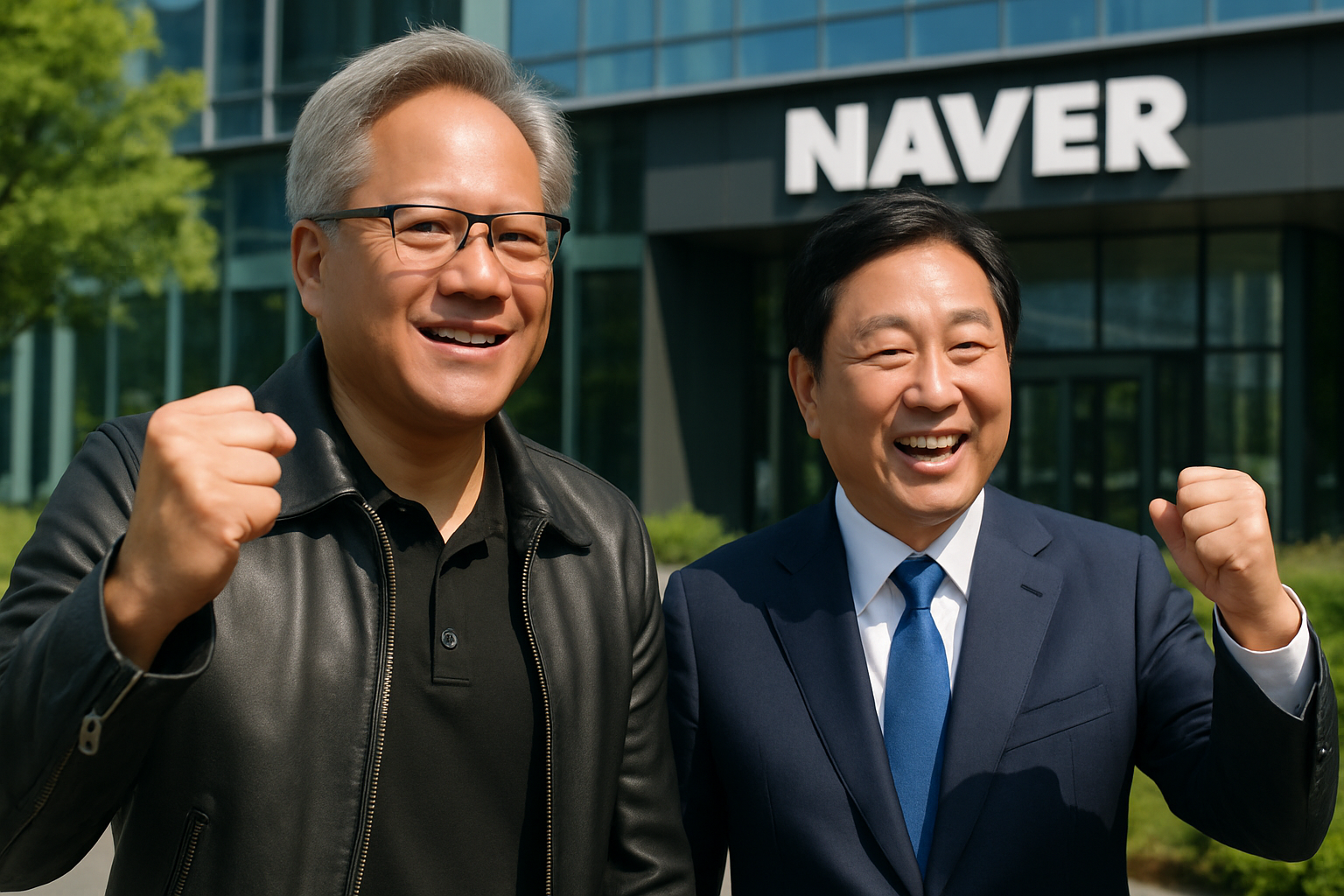
Joining Huang at the table were three of Korea's most powerful business figures: Chey Tae-won, chairman of SK Group; Koo Kwang-mo, chairman of LG Group; and Lee Hae-jin, the founder of Naver — South Korea's dominant internet platform and search engine, often described as the country's answer to Google.
"Go Korea! SK, LG, Naver, cheers!" Huang toasted, raising a glass of somaek — a popular Korean mix of soju and beer — with the assembled tech leaders.
Stepping outside to speak to reporters mid-dinner, Huang was characteristically enthusiastic. "Business is booming!" he said. "Korea is doing very well. My partners in Korea are very important to me. So I came to Korea to thank them, celebrate and congratulate them for such an incredible year. This is just a beginning."
Who Grills the Meat? A Very Korean Question
What's really interesting is that even the small details of the dinner became part of the story. In Korean barbecue culture, there's an unwritten rule: the youngest person at the table handles the grilling. With Huang at 63, Chey at 66, and Lee at 59, the tongs fell to LG's Koo Kwang-mo, 48, who was spotted dutifully grilling the pork belly — a moment he later confirmed himself.
It's a small thing, but it says a lot about how Huang and his team approach these Korean outings. The dinners aren't just photo ops; they're deliberately immersive in local customs, and that authenticity has clearly resonated with Korean audiences.
Speaking of attention to detail — Huang's daughter Madison, who also serves on Nvidia's board, is said to have been deeply involved in selecting the restaurants for the trip, just as she was for last year's Kkanbu Chicken gathering. The bill for the first venue, reportedly paid by Naver's Lee using the restaurant's Naver Pay facial recognition system, came to more than 5.67 million won — roughly $3,600 — covering the entire restaurant.
The Food Tour Doesn't Stop There
Before the pork belly dinner, Huang had already kicked off the Seoul leg with a stop at T1 Base Camp, a PC bang — that's the Korean term for internet gaming cafes, which are a genuine cultural institution in South Korea — where he met Lee "Faker" Sang-hyeok, the legendary captain of esports organization T1's League of Legends team and widely considered the greatest player in the game's history.
"That was my first stop to recognize that GeForce and Korea have been friends for 25 years," Huang said, referencing Nvidia's graphics card line and its long roots in gaming. "And my friend Faker. Do you know Faker? Unbelievable. Incredible gamer."
The food reunions continued throughout the multi-day visit. On Sunday, Huang sat down with Hyundai Motor Group's executive chair Chung Euisun for a Pyongyang-style cold noodle lunch — naengmyeon, a dish with deep roots in Korean culinary tradition. Later, he revisited the Kkanbu Chicken restaurant near Samseong Station, this time joined by SK Group's Chey along with SK hynix CEO Kwak Noh-jung and SK Telecom CEO Jung Jai-hun.
And at an appearance on tvN's beloved talk show "YouQuiz on the Block" — hosted by Yoo Jae-suk, one of Korea's most beloved entertainers — Huang reportedly filmed a segment that is sure to make waves when it airs.
Behind the Banquets: Serious Business
Of course, all of this makes for great optics, but there's genuine strategic weight behind the hospitality. Huang arrived in Seoul with what he called four "gifts" for Korea: Vera Rubin, Vera, RTX Spark, and the Jetson series — a lineup of advanced AI and physical AI chips from Nvidia that rely heavily on memory products made by Korean manufacturers Samsung Electronics and SK hynix, including high-bandwidth memory (HBM) and LPDDR5 chips.
He also confirmed that Nvidia will build a research and development center in Korea, citing the country's "excellent expertise" in AI, robotics, and semiconductors. "Korea is a manufacturing center of the world," Huang said. "We can apply the robotics and the physical AI technologies that we invent here for the industry."
His itinerary for the final days of the trip included meetings with Seoul National University's AI Institute and robotics lab, visits to LG, Hyundai Motor Group, and Naver's futuristic second headquarters — a building called 1784 in Seongnam, Gyeonggi Province — as well as a closed-door session with Korean AI and robotics startup executives at The Shilla Seoul hotel.
Why This All Matters
So step back and look at the bigger picture. Jensen Huang's Korean food tour is easy to frame as entertainment — and honestly, the images of tech billionaires grilling pork belly and handing out doughnuts to crowds of fans do have a certain surreal charm. But what's really happening here is a sustained, high-visibility diplomatic offensive by one of the world's most powerful technology companies, directed squarely at one of the world's most critical semiconductor and AI ecosystems.
Korea supplies much of the memory infrastructure that powers Nvidia's AI chips. In return, Korean companies — from chipmakers to internet giants to automakers — are deeply embedded in the AI supply chain that Nvidia is racing to build. The dinners, the PC bangs, the cold noodles, the baseball games: they're the human layer on top of deals and dependencies worth hundreds of billions of dollars.
And if last year's Kkanbu Chicken moment is any indication, Huang knows exactly what he's doing. The food brings the cameras. The cameras bring the story. And the story keeps Korea — and Nvidia's indispensable role in it — at the center of the global conversation around artificial intelligence.
This article is based on reports from Koreaherald, Koreaherald, Breaknews.