A Historic Moment on the Seoul Stock Exchange
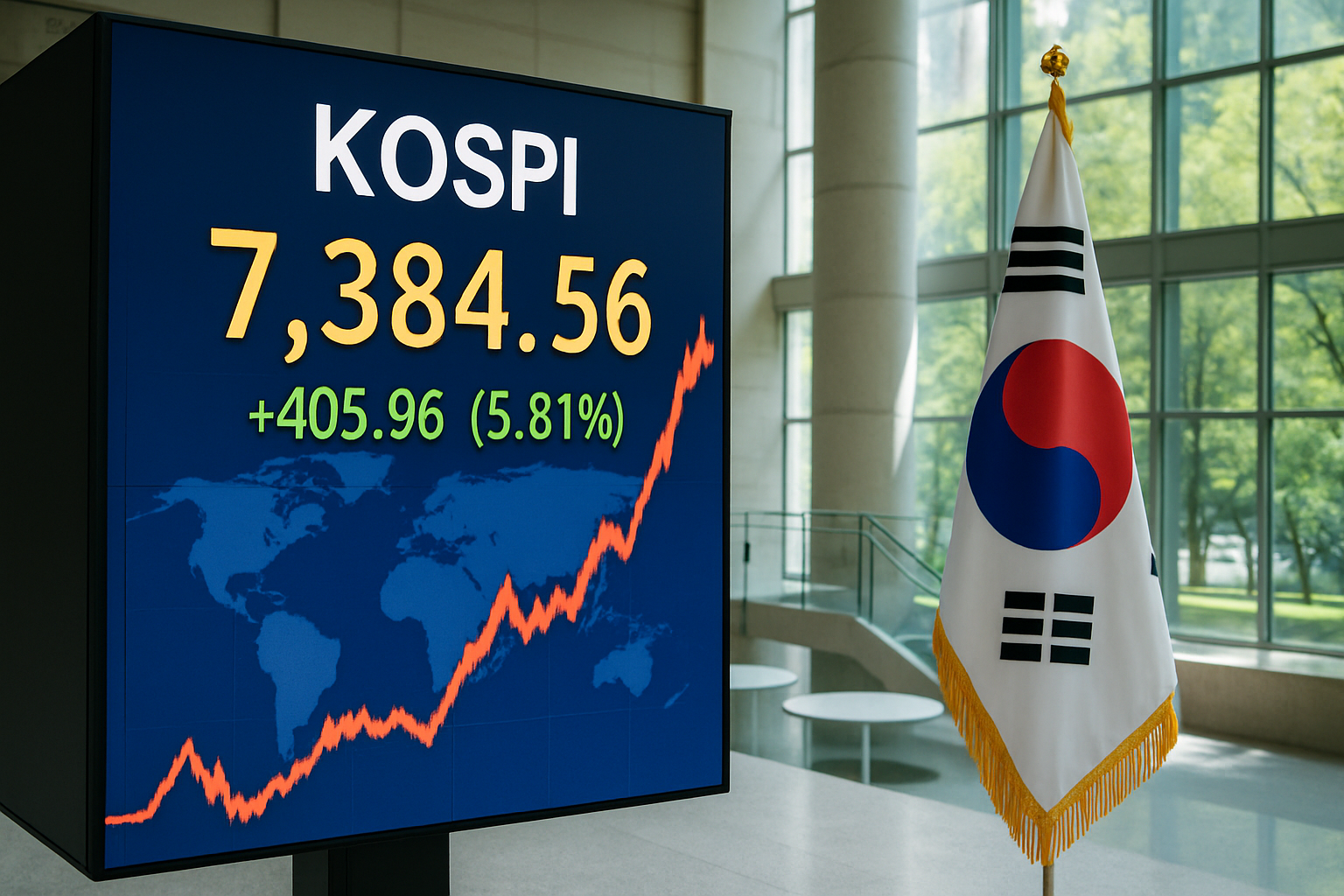
So here's the thing — South Korea just hit a number that investors and policymakers have been dreaming about for years. On May 6, the KOSPI, South Korea's benchmark stock index, smashed through the 7,000-point barrier for the first time in history, closing at a jaw-dropping 7,384.56 — a single-day surge of over 400 points. And just days later, analysts were already floating the idea of KOSPI 8,000 as the next target.
The celebrations were real, and honestly, they were deserved. But if you dig just a little beneath the surface, a much more complicated — and urgent — story starts to emerge.
Who's Actually Driving This Rally?
Two names dominated the headlines that day: Samsung Electronics and SK Hynix, South Korea's semiconductor giants. Together, they essentially carried the index on their backs. Samsung Electronics alone now accounts for somewhere between 15 and 20 percent of the KOSPI's total market capitalization — and on that historic day, its market cap crossed one trillion US dollars for the first time ever, making it only the second company in Asia to join that exclusive club, after Taiwan's TSMC.
What's fueling all of this? The global AI boom. The insatiable demand for high-bandwidth memory, or HBM — the advanced chip technology that powers large-scale AI systems — has triggered what some are calling a memory semiconductor super-cycle. Every time a company like NVIDIA rolls out a new AI chip, it needs Samsung's and SK Hynix's memory to go along with it. The business has been extraordinary.
But here's the uncomfortable truth that experts are pointing out loud and clear: when roughly 80 percent of Samsung Electronics' operating profit comes from semiconductors, and Samsung alone makes up a fifth of your entire stock market, you don't really have a diversified economy. You have a very expensive single point of failure.
The "Semiconductor Diet" Problem
South Korean analysts have started using a blunt phrase to describe the country's economic structure: "semiconductor bias" — or as some put it, a "semiconductor-only diet." The KOSPI doesn't just reflect the health of Korea's broader economy anymore. It reflects the health of one industry, and sometimes just one or two companies within that industry.
The risks are well-documented. Semiconductor demand is notoriously cyclical — what goes up can come down fast. China's aggressive push to build its own chip industry, combined with US export restrictions that could limit Korean firms' access to certain markets, adds a geopolitical layer of uncertainty that isn't going away. And if AI investment enthusiasm were to cool, or global economic growth were to slow significantly, memory chip prices could drop hard — and the KOSPI would feel every bit of it.
Compare this to how other major economies are building their futures. The United States is investing heavily in AI platforms and big tech. China, despite its headwinds, is doubling down on electric vehicles and batteries. India is cultivating a digital manufacturing ecosystem and startup culture. South Korea, for all its strengths, is still heavily reliant on one pillar.
What matters isn't the number 7,000 itself — it's whether that number can be sustained in a healthy way.
So What Comes After Semiconductors?
This is the question that market experts, government officials, and everyday investors in Korea are all asking right now. Big data analysis firm SomeTrend, which tracked online conversations and search trends between April 10 and May 9, found that public interest in the concept of "post-semiconductor" industries has been surging. Keywords like battery technology, potential growth rate, next leading sectors, and fiscal policy all clustered around the topic — a mix of anxiety and anticipation that reflects exactly where the national conversation is right now.
Meanwhile, searches related to the "AI era" brought up associations with NVIDIA, future industries, core technologies, and paradigm shifts — signaling clear optimism about what's next. The bridge connecting both clusters? Terms like AI, semiconductors, investment, companies, and markets. In other words, people aren't just worried — they're actively looking for the next big thing.
So let's talk about what that next big thing might actually be. Four sectors are consistently emerging from the intersection of market analysis and government policy.
1. AI Infrastructure and Power Grids
The AI era is, at its core, a power consumption era. A single ChatGPT query uses roughly ten times the electricity of a Google search — and the world is running billions of these queries every day. Global data center construction is expected to continue expanding through at least 2028, driving enormous demand for high-voltage transformers and power equipment.
The South Korean government has already moved, securing 15,000 units of NVIDIA's next-generation "Vera Rubin" GPUs to strengthen the domestic AI ecosystem. Companies like HD Hyundai Electric and LS Electric — both major players in power infrastructure — are moving beyond being mere "theme stocks" and are now starting to prove their value through actual earnings results.
2. Robotics
South Korea has one of the lowest birth rates in the world and is aging faster than almost any other developed nation. Robots aren't just a cool tech story here — they're a structural economic necessity. Hyundai Motor, through its subsidiary Boston Dynamics, is aiming for mass production of the humanoid robot "Atlas" by 2028. Samsung Electronics has brought Rainbow Robotics in-house as a subsidiary, signaling that robotics is now a core future business for the conglomerate.
On the government side, Seoul has launched the "K-Humanoid Alliance," a program committing three trillion Korean won — roughly 2.2 billion US dollars — to train 15,000 robotics specialists by 2030. Smaller, specialized players like SBB Tech, which has achieved domestic production of key robot components like reducers, and Doosan Robotics, targeting the collaborative robot market, are also drawing serious investor attention.
3. Space and Defense
Russia's war in Ukraine fundamentally changed the calculus around defense spending in Europe and beyond, and South Korean defense companies are benefiting from that shift in a major way. At the same time, rising tensions in the Indo-Pacific are creating new export opportunities that simply didn't exist a few years ago.
Hanwha Aerospace stands out as a company that combines the stability of defense exports with the long-term growth story of space technology — which explains why both foreign and institutional investors have been steadily adding it to their portfolios. Korea Aerospace Industries (KAI) is also gaining recognition as a key participant in civilian space development.
4. EV Components, HVAC, and Digital Healthcare
The fourth pillar is a broader category that includes electric vehicle components, advanced heating and cooling systems (particularly relevant for data centers and EVs alike), and digital healthcare technology — areas where Korean manufacturers already have strong competencies and are well-positioned to scale.
The Bigger Picture
South Korea's stock market hitting 7,000 — and eyeing 8,000 — is genuinely exciting. It reflects real corporate achievement, real technological leadership, and real investor confidence. But the editorials and analysts saying "don't pop the champagne just yet" have a point that's hard to argue with.
A healthy, sustainable stock market milestone needs to be built on a diversified foundation — one where innovative companies across multiple sectors are continuously emerging, and where capital flows productively into a range of industries, not just one. The KOSPI's next chapter won't be written by semiconductors alone. It will be written by whether South Korea can nurture the industries that come after.
The 7,000 milestone is a starting line, not a finish line. And the clock is already ticking.
This article is based on reports from Businesspost, Naver News, Cbci.