Three Stories, One Thread: Korea's Cultural Ambitions Are Going Places
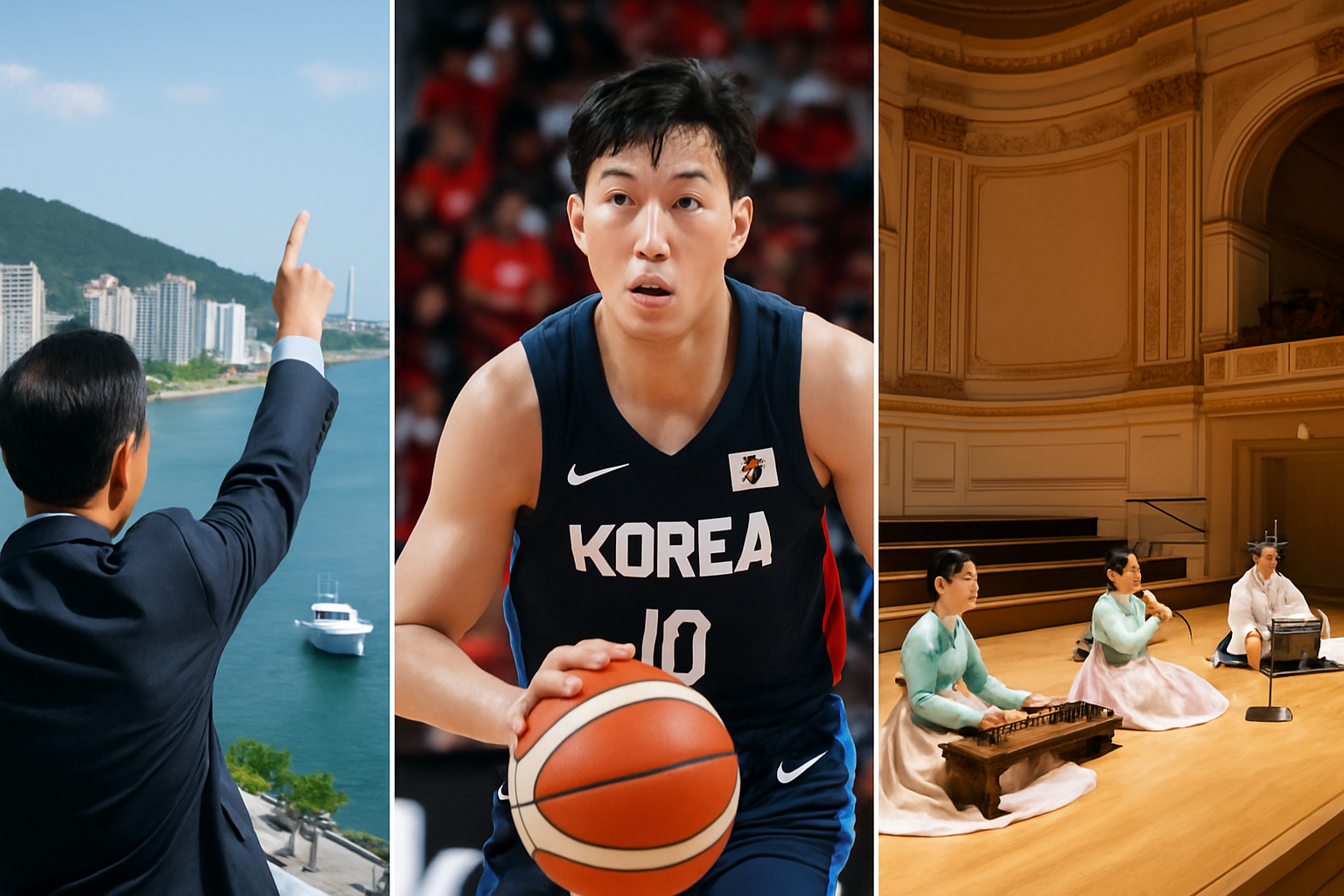
So this week gave us a fascinating snapshot of just how broadly Korean culture is reaching out — and reaching up. We have a mayoral candidate in a coastal city dreaming of building Asia's answer to Cannes, a national basketball guard who simply refuses to lose while wearing the Korean jersey, and a traditional music ensemble that had an Egyptian audience completely spellbound. Let's get into all three.
The City That Wants to Be Asia's Cannes
If you haven't heard of Yeosu, picture this: a scenic port city on South Korea's southern coast, famous for its glittering night sea views and fresh seafood. Now, one political candidate wants to add "internationally renowned film festival host city" to that description.
Myeong Chang-hwan, the Cho Kuk Innovation Party candidate running for mayor of Yeosu in the upcoming local elections, made headlines on May 24th when he unveiled his flagship cultural policy pledge — the Yeosu International Film Festival Project.
What's really interesting here is the level of strategic thinking behind it. This isn't just "let's throw a festival and hope people show up." Myeong wants to carve out a very specific niche in the global film calendar. His plan is to lock in early June every year as the festival's window — that's right after the Cannes Film Festival wraps up in France, and months before the Busan International Film Festival, which is already Korea's most prominent film event, kicks off in the fall. In other words, he's eyeing a gap in the global film circuit and wants Yeosu to fill it.
And the differentiation strategy from Busan is deliberate. Myeong wants Yeosu's festival to become South Korea's first international film festival with a dedicated competition section exclusively for Korean films — specifically new works premiering for the first time anywhere in the world. The idea is to give emerging Korean directors and independent filmmakers a high-profile global launchpad that doesn't yet exist in that form.
The top prize would be called the Golden Camellia Award — a nod to the camellia flower that blooms across South Korea's southern coast — and the total prize fund would sit at around 300 million Korean won, roughly 220,000 US dollars. Delegations from Cannes, Venice, and Berlin would be invited to attend, lending the event international credibility from day one, at least in theory.
"Culture is the city's future industry and economy. I will create the best cultural and economic city on the southern coast."
But Myeong's vision extends well beyond a single annual festival. He's pitching what he calls a "Total Art Festival" model — essentially making Yeosu a year-round cultural destination. Think K-pop stages, street theater, film music concerts, busking nights, media art installations, and Korean food events running continuously across the city's most beloved spots: the famous Yeosu Night Sea waterfront, Ungcheon district, Romantic Pocha Street, and even the remote island of Geomundo.
He invoked Edinburgh — the Scottish capital that transforms every August into the world's largest arts festival — as the model. "I want every street to breathe with performance and art," he said, adding that he wants tourists to stay, spend money, and come back, rather than just passing through.
On the funding side, the plan calls for a three-way partnership between Yeosu city, the proposed Jeonnam-Gwangju Integrated Special City — a planned administrative merger of South Jeolla Province and Gwangju — and private sector companies, including firms from the Yeosu National Industrial Complex. Long-term, Myeong also floated the idea of building a dedicated film museum and developing an AI-based independent film and content industry hub. His target: three million tourists a year drawn in by the festival ecosystem.
Whether or not he wins the mayoral race, the proposal itself signals something real about how Korean cities are thinking about culture as economic infrastructure — not just decoration.
The Guard Who Won't Lose in a Korean Jersey
Shifting gears entirely — over the weekend in Goyang, just northwest of Seoul, the 2026 KBA 3x3 Prime League held its second tournament of the season. For those unfamiliar, 3x3 basketball is the half-court, three-on-three format that became an Olympic sport at Tokyo 2020. It's fast, physical, and very different from the five-on-five game.
Team Korea — the national squad — won the second tournament, just as they'd won the first one back in March. In between, they also claimed a runner-up finish at the 2026 FIBA 3x3 Asia Cup. The team is on a serious roll.
The standout performer in the final against a team called Black Label was Lee Joo-young (189cm, guard), a student-athlete at Yonsei University — one of Korea's most prestigious universities and a traditional powerhouse in college basketball. He hit clutch shots from beyond the arc throughout the game and sealed the win with a decisive two-pointer at the end.
What makes Lee's interview after the game so compelling is his almost uncomfortable honesty. He admitted his performance was running at less than fifty percent — he'd been stuck at university dealing with his college league schedule right up to Friday night before Saturday's games. "I think I showed somewhat disappointing play," he said. "But I'm just glad the result came out well."
He was also refreshingly grounded about the growing expectations following the Asia Cup silver medal. People around him have been saying Team Korea can win gold at the Asian Games, and rather than crumbling under that pressure, Lee has chosen to treat it as fuel.
"When I'm wearing the national team uniform, I feel that we simply cannot lose — against any team, in any competition, domestic or international. I'm not the only one who feels that way. I think that's why the results keep coming."
That sense of collective responsibility — everyone on the roster holding that same standard — seems to be a genuine cultural glue for this team. Lee credited the role clarity within the squad too, noting that each player knows their job: Kim Seung-woo is a shooting threat, Lee Dong-geun works inside but also has range, and Lee himself balances perimeter shooting with drives and layups.
Back at Yonsei, though, things are tougher. The team sits at five wins and four losses — underwhelming by the school's historical standards. Lee was frank about it: "We are no longer a top-tier team. We're a team that has to climb back up from the lower ranks." He acknowledged that other university programs have developed strong rosters, and that the old Yonsei-Korea University rivalry that used to dominate college basketball has given way to a much more competitive landscape across the board.
As for the Asian Games — China and Mongolia are on his radar as physical, difficult matchups, and he flagged Middle Eastern teams from Qatar and Iran as dangerous opponents too. The goal is gold. The mentality is already there.
Korean Traditional Music Finds a Home in Cairo
And then there's the story that might be the most quietly remarkable of the three. On May 5th and 6th, a Seoul-based contemporary gugak ensemble called Goodmori — written in Korean as 굿모리 — performed in Cairo, Egypt, as part of events marking the 30th anniversary of diplomatic relations between South Korea and Egypt.
A quick note for those unfamiliar: gugak (국악) refers to traditional Korean music, encompassing a wide range of classical and folk forms. Goodmori, founded in 2007 by artistic director Kwon Eun-sil, sits at the intersection of gugak and contemporary composition. They commission new works from composers in Korea and abroad — over a hundred pieces to date — and perform them on traditional Korean instruments like the gayageum (a twelve-stringed zither), daegeum (a large transverse bamboo flute), haegeum (a two-stringed fiddle), and janggu (an hourglass drum), often alongside Western instruments like violin and piano.
The Cairo invitation came through an unexpected but lovely connection. Professor David Rafferty, who serves as Music Program Director at The American University in Cairo — a prestigious English-language private university founded in 1919 and considered a major intellectual center of the Arab world — studied composition under Kwon Eun-sil when he was in Korea. He went on to complete graduate degrees in the UK and Canada before joining AUC's faculty, and he was the one who brought Goodmori to Cairo. He even served as MC for the concert.
For Kwon, it was a reunion with a former student. "It felt like a small seed I had planted — Rafferty — had grown into this remarkable fruit," she said.
The main concert at AUC's Malak Gabr Arts Theatre blended traditional Korean repertoire — including the daegeum solo piece Cheongseonggok, the classical ensemble work Yeongsanhoesang, and a solo janggu drum performance — with two world premieres composed specifically for the Cairo occasion. Kwon's own piece, White Shadow II for Quintet, drew on the visual textures of Egypt's Sahara White Desert. Composer Lee Seung-eun's Egypt Is the Gift of the Nile took the Nile River as its central image, musically tracing the flow of water, the passage of time, and the breath of civilization.
The highlight of the evening, by all accounts, was the collaboration with AUC's Arab Music Ensemble and choir. When the daegeum and haegeum met the melodic modes of Arab classical music, something new and genuinely surprising emerged from the combination. And then came the improvised percussion duel between guest performer Choi Byeong-gil on janggu and an Egyptian tabla player — a moment that reportedly brought the whole room to its feet.
Kwon admitted she'd worried beforehand about how Cairo audiences would receive music so unfamiliar to them. That worry turned out to be unnecessary. "The understanding of K-culture that has spread through Egypt, combined with the intrinsic appeal of our traditional music, turned the concert hall into a place of pure emotion," she said.
The audience's comments afterward were telling. Several noted that Korean traditional vocal music — jeong-ga, the classical song form — felt entirely distinct from Chinese opera or Japanese kabuki. "Elegant from beginning to end," was one response.
Goodmori will continue their international exchange work in October, with a collaborative concert featuring Poland's Kwartludium Ensemble scheduled for October 31st at the Biseul Hall of their local culture center.
A Common Thread
So here's the thing — when you look at all three of these stories together, they're really about the same underlying impulse. Whether it's a politician imagining his city as a cultural hub, an athlete channeling national pride into competitive excellence, or musicians carrying centuries-old sounds into a Cairo concert hall, there's a shared belief at work: that Korean culture has something distinct and valuable to offer the world, and that now is the time to push it further. It's a belief that, increasingly, the rest of the world seems to agree with.
This article is based on reports from Breaknews, Basketkorea, Idaegu.