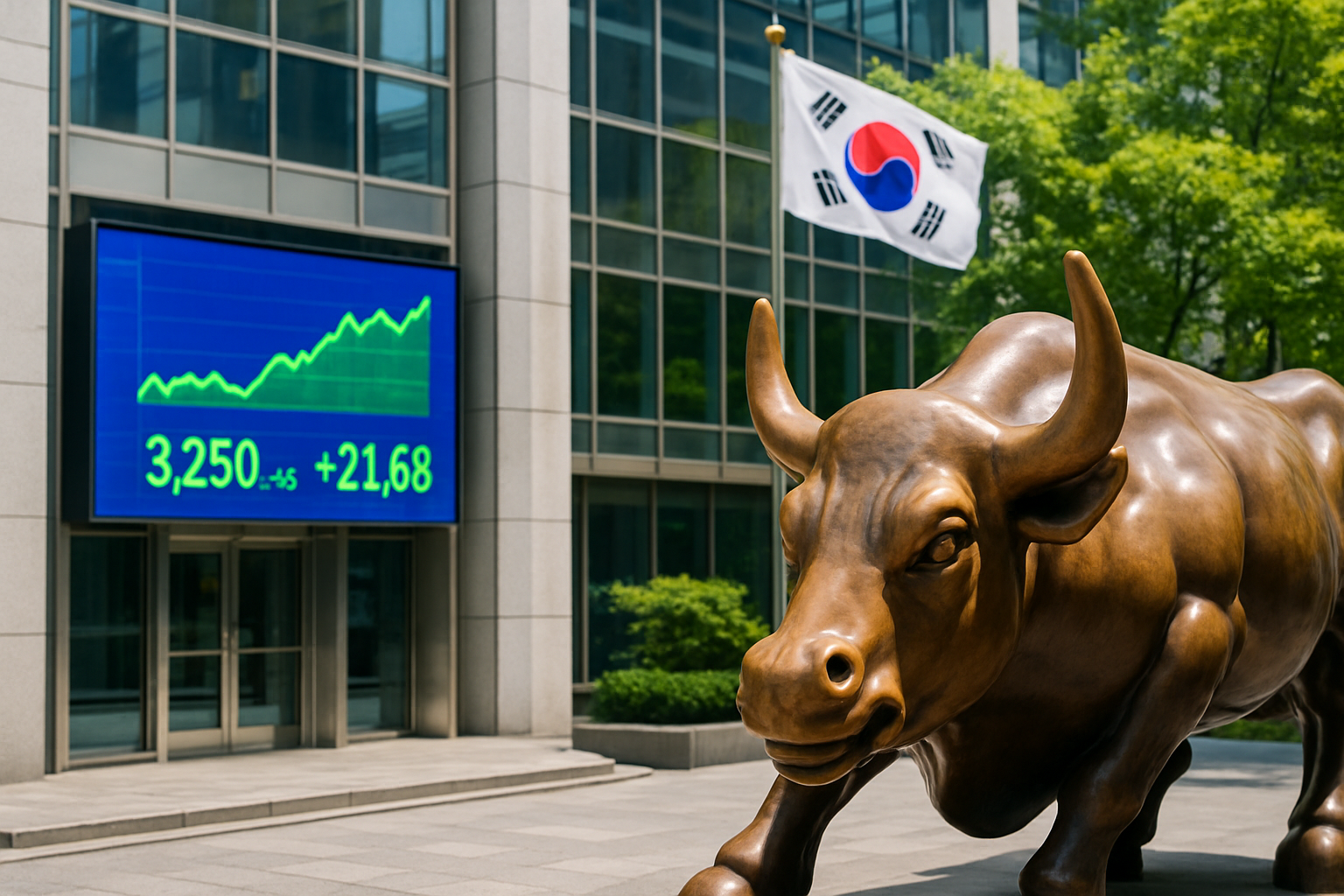
A Historic Moment on Wall Street
So here's the thing — when SK Hynix recently made headlines for listing American Depositary Receipts (ADRs) on U.S. stock exchanges, a lot of people in Korea's financial world felt something more than just excitement about a corporate milestone. For many market participants, it felt like a long-overdue moment of recognition. One of the world's most critical semiconductor companies, a pillar of South Korea's entire tech industry, was finally stepping into the world's largest financial market and saying: "Evaluate us on our merits."
But to understand why this matters so deeply, you have to know about something called the "Korea Discount" — and why it has haunted Korean businesses for decades.
What Is the Korea Discount, and Why Does It Matter?
The Korea Discount refers to the long-standing tendency for Korean companies to be valued significantly lower on financial markets compared to their global peers, even when their technology, revenue, and fundamentals are world-class. Think about that for a second. A company can be a global leader in memory chips, generate billions in profit, and still trade at a fraction of what a comparable Western firm would be worth. Why? Analysts have pointed to a mix of factors over the years: geopolitical risk from the Korean peninsula, opaque corporate governance structures, and a persistent culture of prioritizing founding family interests over ordinary shareholders.
What's really interesting is that the current South Korean government has made tackling this discount a central policy priority from day one. And the tools they're reaching for are ambitious.
Government Reform: The Legal Foundation for Change
At the heart of Seoul's push for capital market reform is a proposed revision to the Commercial Act — Korea's foundational corporate law. The key change? Expanding the fiduciary duty of corporate directors from serving "the company" to serving "all shareholders." That might sound like legal jargon, but the implications are massive. It means minority shareholders — the everyday investors who hold small stakes in Korea's giant conglomerates — would have far stronger legal standing to demand that executives act in their interest.
Alongside this, the government has rolled out what it calls a "Corporate Value-up Program," designed to push listed companies to disclose how they plan to improve their price-to-book ratios and shareholder returns. These aren't just symbolic gestures. Combined, they represent a genuine attempt to rewire the incentive structures that have kept Korean corporate governance lagging behind global standards for years.
The Rise of Shareholder Activism — With a New Face
Now, here's where things get really dynamic. As this regulatory environment has shifted, shareholder activism in Korea has surged — and it looks nothing like it used to. If you go back ten or fifteen years, activism in Korean markets was largely seen as a dirty word. Foreign hedge funds would swoop in, make noise, try to extract short-term gains, and leave. Locals called them "corporate raiders," and the term stuck.
But the new wave of activism is different in character. Domestic and international private equity funds, asset managers, and even coalitions of retail minority shareholders are now making sophisticated, governance-based arguments. They're showing up at shareholder meetings armed with detailed financial analyses, demanding things like increased dividend payouts, share buybacks and cancellations, and the divestiture of underperforming or non-core business units. The requests are no longer just noise — they're being taken seriously.
Where activism was once seen as corporate raiding, it is now increasingly viewed as a form of strategic partnership aimed at restoring fair valuations and improving governance.
And crucially, the government's push on the Commercial Act revision has given these activists real legal wind in their sails. When minority shareholders know their rights are backed by law, the conversation with management changes fundamentally.
When Activism Leads to M&A: The Next Frontier
So here's the most important part of this story — and it's one that hasn't gotten nearly enough attention globally. The current wave of shareholder activism in Korea isn't just producing better dividend policies or cleaned-up balance sheets. It is beginning to trigger actual mergers and acquisitions.
The logic works like this: an activist fund acquires a meaningful stake in a company that is trading well below its intrinsic value. The fund then pushes for structural changes — spinning off non-core divisions, unlocking hidden asset value, replacing inefficient management. If those demands aren't met, or if the analysis reveals that the entire business would be better served under different ownership, the pressure escalates toward a full sale of the controlling stake. The result? A change in ownership, a restructuring of the business, and — ideally — a company that finally trades where it should.
This is M&A functioning exactly as financial theory says it should. Rather than viewing acquisitions as hostile takeovers or predatory moves, economists describe M&A as the most efficient mechanism for reallocating capital in a market economy. When a controlling shareholder is no longer the best possible steward of a company's assets, the market — through activism and M&A — finds someone who is.
Why M&A Is Good for Markets — and for Korea
It's worth spelling out why this matters beyond the boardroom. Healthy M&A activity serves several functions that benefit the broader economy:
- Efficient allocation of resources: Companies get matched with owners and managers who can extract the most value from their assets, boosting productivity across the economy.
- Exit opportunities for investors: Minority shareholders and early-stage investors get a fair chance to monetize their holdings, which encourages more capital to flow into the market in the first place.
- Market discipline: The ever-present possibility of being acquired keeps management teams focused on shareholder value rather than entrenched self-interest — a key check on what economists call "agency costs."
For Korea specifically, a functioning M&A market could be one of the most powerful antidotes to the Korea Discount. When companies know they can be bought and restructured if they underperform, the pressure to perform — and to be transparent — increases dramatically.
SK Hynix's ADR Listing as a Symbol of the Shift
Coming back to where we started — SK Hynix's ADR listing on U.S. exchanges is not just a capital-raising move. It is a signal that Korean companies are confident enough in their governance and their story to submit themselves to the scrutiny of the world's most demanding investors. American institutional investors, who will now be able to hold SK Hynix shares directly, will ask hard questions. They will expect transparency. They will demand shareholder-friendly policies. And that pressure, in turn, will ripple through the entire Korean corporate ecosystem.
None of this happened overnight. It is the product of years of regulatory debate, a government willing to push through uncomfortable structural reforms, and a new generation of activist investors who are making the case that Korean companies deserve to be valued on a global standard.
A New Chapter for Korean Capital Markets
South Korea's capital markets are at a genuine turning point. The combination of legal reform, emboldened shareholder activism, and a growing M&A culture is beginning to dismantle the structural inefficiencies that caused the Korea Discount in the first place. It won't happen all at once — these things rarely do — but the direction of travel is clear.
For global investors watching from the outside, Korea is increasingly looking like a market where the rules are getting fairer, the companies are getting more transparent, and the opportunities are getting harder to ignore. That's a story worth paying attention to.
This article is based on reports from Junggi, Bntnews, Bntnews.