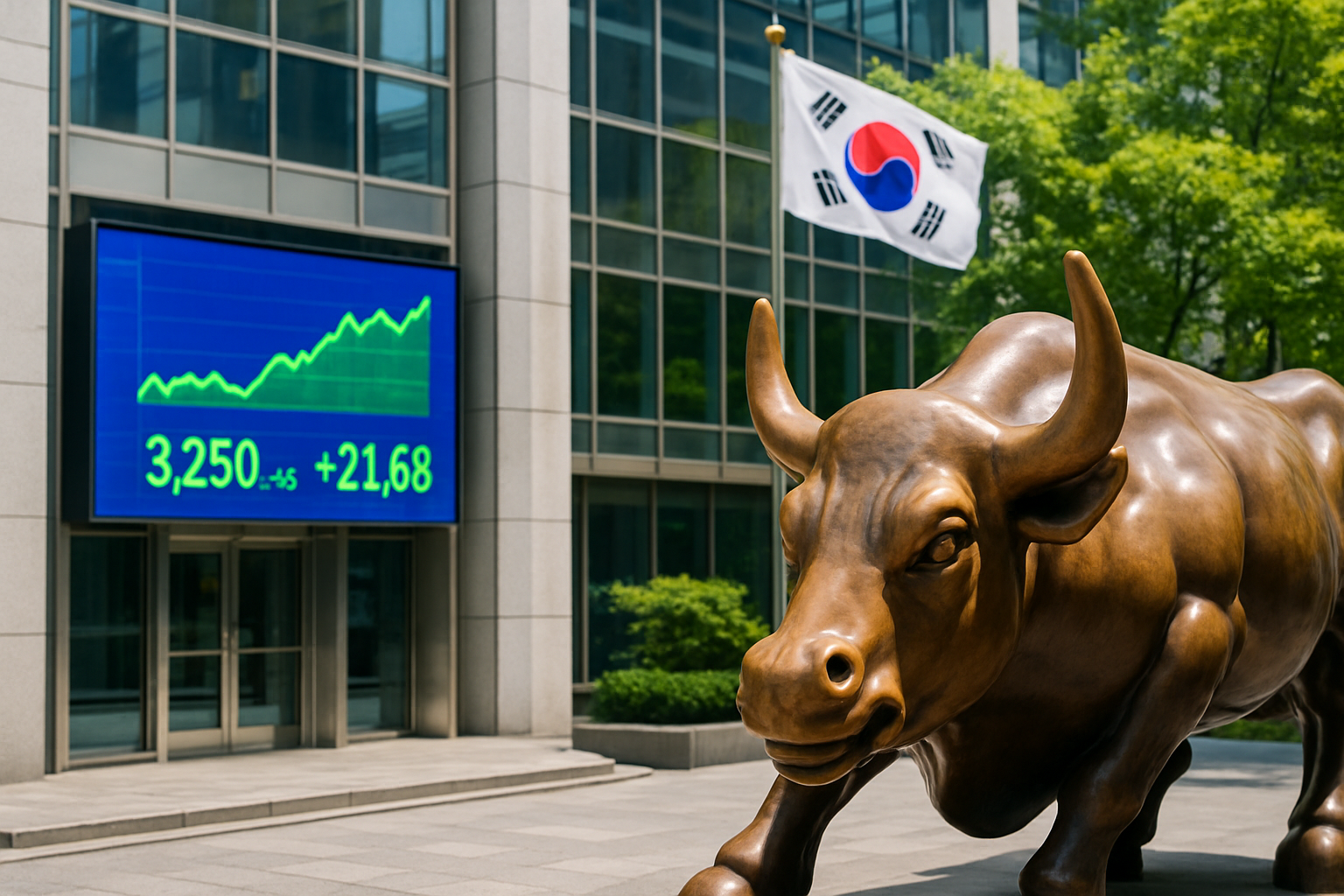
A Stock in Two Worlds
So here's a situation that really makes you stop and think. Take one company — SK Hynix, one of the world's leading memory chip makers — and watch what happens when it shows up in two different markets at the same time. In South Korea, its stock has been in freefall, triggering a regulatory crackdown. In the United States, the same company's shares debuted on Nasdaq to a warm welcome, with Wall Street rushing to launch new financial products around it. Same company, very different story.
This contrast has become one of the most talked-about market dynamics in Korean financial circles right now, and it raises some serious questions about how leveraged investment products were introduced to Korean retail investors — and whether the timing could have been any worse.
The Numbers Tell the Story
Let's start with what's actually been happening on the ground. According to the Korea Exchange, SK Hynix shares dropped 11.53 percent on July 16 alone, closing at 1,842,000 Korean won. That followed an even steeper plunge of 16.15 percent just days earlier on July 13. We're talking about double-digit drops within the same week for one of Korea's most prominent companies.
Meanwhile, over in New York, SK Hynix made its Nasdaq debut through an ADR — an American Depositary Receipt, which is essentially a way for non-U.S. companies to be traded on American stock exchanges. The ADR was priced at an IPO of 149 dollars per share, structured so that ten ADR shares equal one Korean common share. And on its first day of trading? It opened at 170 dollars, surged as high as 177 dollars intraday, and closed at 168.01 dollars — still 12.75 percent above the offering price. Even after a 9.32 percent dip on the second trading day, it remained above that original IPO price. Through the ADR, SK Hynix raised approximately 26.5 billion dollars in total.
What's really interesting is how quickly the American financial industry moved to build products around it. Asset managers including Direxion, Corgi, T-REX, GraniteShares, and Leverage Shares all launched or announced leveraged ETFs tied to the SK Hynix ADR, with Direxion's offering tracking twice the daily return of the ADR. The appetite was clearly there.
When the Timing Goes Wrong
Back in Korea, the story of leveraged ETFs — exchange-traded funds that amplify returns, typically by two times the daily movement of an underlying asset — is a much more painful one. On May 27, Korean regulators approved the launch of 16 single-stock products all at once, including 2x leveraged ETFs based on Samsung Electronics and SK Hynix. At the time, the KOSPI index was riding high on the global AI semiconductor boom, and investor deposit balances had swelled to record levels.
That timing, in retrospect, looks disastrous. Bloomberg columnist Shuli Ren wrote a piece on July 15 titled "Korea's Leveraged ETFs Have the Worst Timing," arguing that because these products launched near the market peak, ordinary retail investors missed most of the upside and are now absorbing the full weight of the downturn. She described the regulator's decision to approve the products as "pouring oil on a burning fire."
The numbers back that up. The domestic 2x leveraged ETF tied to SK Hynix has lost more than 40 percent of its value in just over a month since launch. Compare that to the CSOP SK Hynix 2x leveraged ETF listed in Hong Kong back in October 2024 — that product, which got in early on the AI chip rally, has returned roughly 270 percent so far this year. Same underlying asset, completely different outcome — all because of when you got in.
The Structural Problem Korea Faces
So here's the thing — it's not just about bad timing. There's a deeper structural issue at play. In the United States, hundreds of single-stock leveraged products trade across a wide range of companies. Even Nvidia, the poster child of the AI chip boom, only represented about 2 to 3 percent of major U.S. index weighting when its first leveraged ETF launched, and even today accounts for around 8 percent.
In Korea, Samsung Electronics and SK Hynix together make up roughly 65 percent of the KOSPI 200 index weighting, and nearly half of the MSCI Korea ETF. Park Woo-yeol, an analyst at Shinhan Investment Securities, put it plainly:
"Since Samsung Electronics and SK Hynix account for around 65 percent of the KOSPI 200 and close to half of the MSCI Korea ETF, any volatility in these individual stocks has a proportionally much larger impact on the overall index."
That concentration is a serious problem when you add leveraged products into the mix. These ETFs are designed to rebalance daily to maintain their 2x exposure — which means fund managers are mechanically buying and selling large quantities of these already heavily-weighted stocks every single day. When markets move sharply, that rebalancing can actually amplify the price swings rather than simply reflect them.
Regulators Step In — Fast
The response from Korean financial authorities came swiftly. On July 16, a market stability review meeting chaired by the Deputy Prime Minister for Economic Affairs produced a set of emergency measures targeting single-stock leveraged products.
Here is what was announced:
- A temporary suspension of new listings for single-stock leveraged, inverse, and covered-call ETFs until market conditions stabilize
- A ban on advertising and promotional marketing events for these products
- A tripling of the minimum required deposit to participate — from 10 million Korean won to 30 million won (roughly equivalent to raising the entry barrier from about 7,300 USD to 22,000 USD)
- A tightening of the liquidity provider price deviation tolerance from 3 percent to 2 percent
- An increase in mandatory investor education from two hours to three hours before participation
The fact that these measures arrived less than two months after the products were first approved has led many market observers to question whether the original decision to greenlight them was too hasty. The regulatory reversal is an implicit acknowledgment that something went wrong — whether in the product design, the launch timing, or the market concentration risks that weren't adequately considered.
Two Markets, One Lesson
What this episode really highlights is how context shapes outcomes in finance. SK Hynix is the same innovative, globally significant semiconductor company whether you're looking at it from Seoul or New York. But the market infrastructure around it — the concentration of index weight, the limited diversity of underlying assets for leveraged products, the timing of the launch — made all the difference in how this story played out for Korean retail investors.
The American market's ability to absorb and distribute single-stock leveraged products across hundreds of names provides a natural diversification buffer. Korea's version, concentrated almost entirely around two chip giants during a moment of peak market euphoria, did not have that cushion. For the many individual investors who piled into these products hoping to ride the AI wave, the lesson has been an expensive one.
This article is based on reports from News, Naver News, Naver News.