A Big Friday on the Korean Stock Market
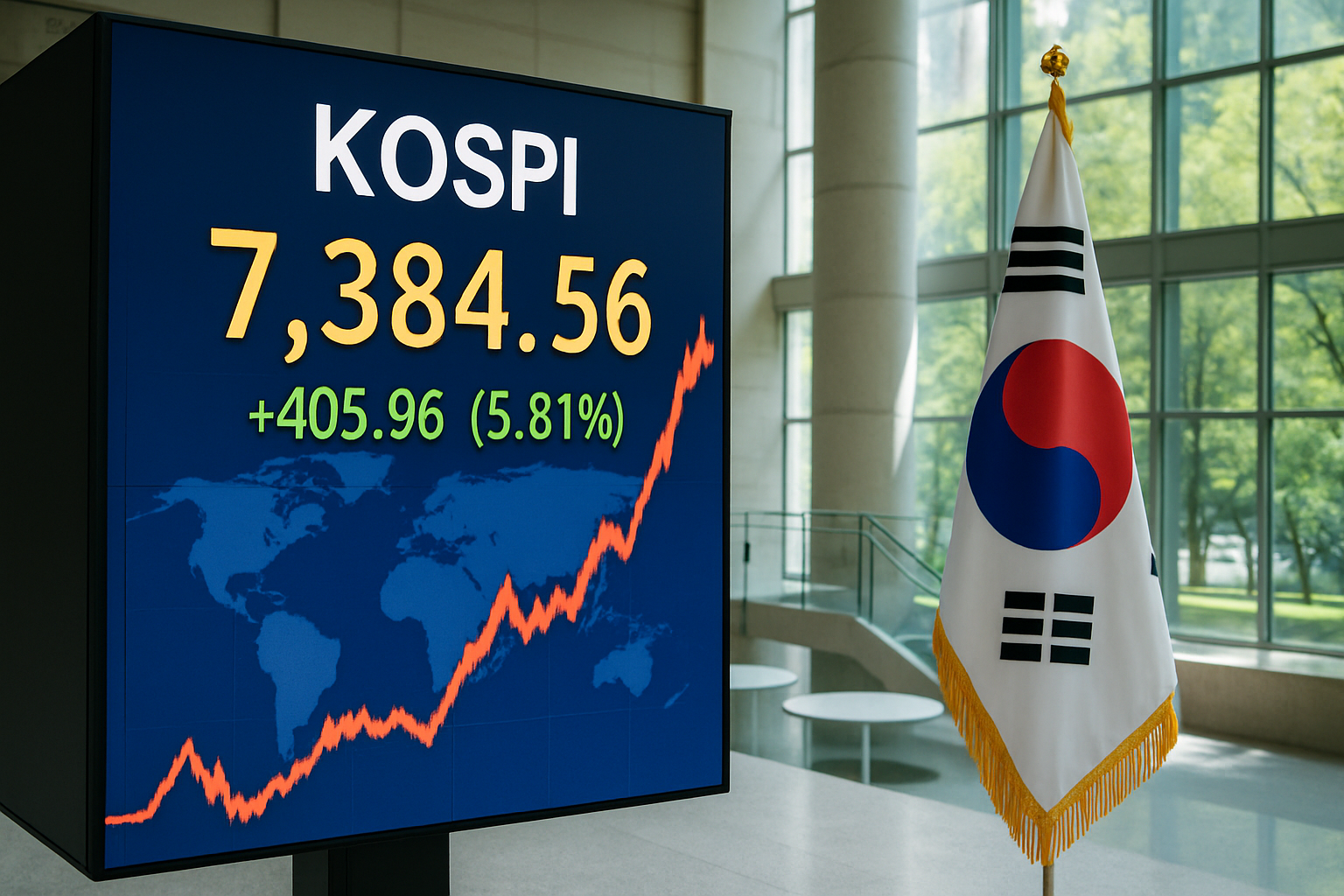
So here's the thing — if you were watching South Korean markets on Friday, June 12, you witnessed one of those rare days where the numbers almost feel unreal. The benchmark Korea Composite Stock Price Index, better known as the KOSPI — South Korea's main stock market index, similar to the S&P 500 in the United States — closed up a massive 359.67 points, or 4.63 percent, settling at 8,123.62. That puts it back firmly above the psychologically significant 8,000-point mark, a threshold that investors and analysts have been paying very close attention to in recent months.
At its intraday peak, the KOSPI actually climbed as high as 8,434.40 before pulling back somewhat. What's really interesting is that the retreat from that high wasn't driven by bad news — it was classic profit-taking. When a market surges that fast, some investors simply lock in their gains before the closing bell, which is exactly what happened here. Still, a 4.63 percent single-day gain is nothing to shrug at. That's a significant move for any major market index.
What Was Driving the Rally?
The fuel behind Friday's surge? Hopes that the monthslong war between the United States and Iran may finally be coming to an end. Markets, as they often do, moved on the news before any deal was officially signed — because that's how sentiment works. When big geopolitical risks start to look like they might resolve, investors tend to move fast.
The catalyst came on Thursday, U.S. time, when President Donald Trump publicly announced that he had reached what he called a "great settlement" to resolve the conflict with Iran. He added that the deal could be signed as early as the weekend, potentially somewhere in Europe. That was enough to send markets in Asia into rally mode when they opened Friday morning.
Adding fuel to the fire, the media outlet Axios reported that four U.S. Air Force C-17 transport aircraft departed for Europe on Thursday, reportedly moving equipment in preparation for possible travel by Vice President J.D. Vance. The reporting raised speculation that a formal signing ceremony could take place in Geneva, Switzerland — lending the whole thing a sense of imminent, concrete reality rather than just diplomatic talk.
Tech Heavyweights Led the Charge
It wasn't just a broad market lift, either. Investors specifically snapped up tech heavyweights — the big-name technology companies that carry enormous weight in the KOSPI's overall movement. South Korea's stock market has a heavy concentration in technology and semiconductor firms, so when global risk sentiment improves and geopolitical tensions ease, those are often the first stocks to benefit. Companies in that space are deeply tied to global supply chains and export demand, both of which get a boost when the prospect of a major military conflict fading from the picture.
Why the 8,000 Level Matters
For context, the KOSPI breaking and holding above 8,000 points is a big deal in the current climate. The index has been navigating a turbulent stretch driven by a combination of global factors — U.S.-Iran tensions, concerns about inflation, and broader uncertainty in global tech markets. Reclaiming that level, even after trimming intraday highs, signals a degree of renewed investor confidence that market watchers will be closely monitoring heading into next week.
The fact that the market opened "sharply higher" and then moderated — rather than surging and immediately collapsing — also suggests the rally had some underlying conviction to it. Pure panic-buying tends to unwind quickly; a sustained close above 8,100 suggests investors are making a more considered bet that the geopolitical situation is genuinely shifting.
What Comes Next?
All eyes now turn to the weekend and whether that U.S.-Iran deal actually materializes in a formal signing. If it does, expect markets across Asia — and South Korea in particular — to respond positively when trading resumes Monday. If the deal stalls or falls through, don't be surprised to see some of Friday's gains give back quickly.
South Korea, as one of Asia's most export-driven economies and a major hub for semiconductors and consumer electronics, is especially sensitive to shifts in global geopolitical stability. A resolution to the U.S.-Iran conflict would ease pressure on global energy prices and supply chains, both of which have direct downstream effects on Korean industry. So this isn't just about stock prices — the broader economic implications for the country are real.
For now, though, Friday was a good day on Yeouido — the financial district in Seoul where the Korea Exchange is based. Whether it's the start of a sustained recovery or a one-day bounce remains to be seen, but the market has spoken loudly: investors are ready to price in peace.
This article is based on reports from Yonhap News, Yonhap News, Koreatimes.