A Square Full of ARMYs and a President on the Balcony
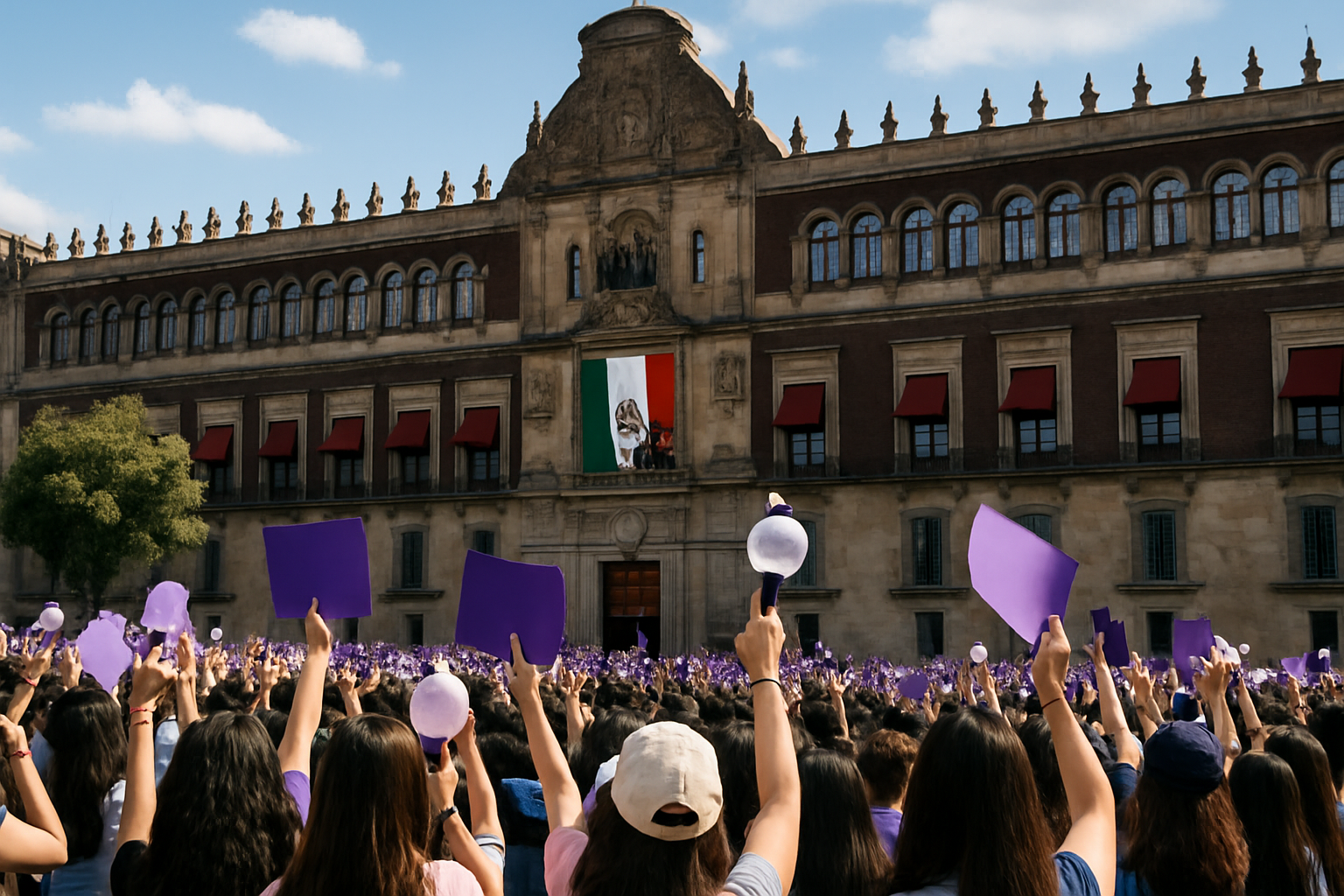
So here is a scene that pretty much sums up where Korean culture stands right now: it is June 6th, local time, in Mexico City. The Zocalo — that massive public square in front of the National Palace — is packed with 50,000 people. They are not there for a political rally. They are there for BTS.
When the seven members appeared on the presidential palace balcony alongside Mexican President Claudia Sheinbaum, the roar from the crowd was, by all accounts, something else entirely. In the words of more than a few Korean media commentators, that two-minute moment is already being called one of the defining images in the history of the Korean Wave, or Hallyu.
And it is just the beginning. BTS's 2026 world tour — with its full South American leg scheduled for October, covering Colombia, Peru, Chile, Argentina, and Brazil — has not even hit its main stretch yet. Fans across the continent are reportedly already competing to outdo the Mexico City energy. That is a high bar to clear.
Latin America Is Not Just a Stop on the Tour
What's really interesting is just how deep the Korean Wave has actually sunk into Latin American soil. This is not a recent thing, and it is not casual fandom.
According to data cited by Mexican daily El Universal, Mexico City has overtaken Seoul and Jakarta — two cities that have long been considered the spiritual homes of K-pop — to become the number one city on Spotify for BTS streams. More than 700,000 unique monthly listeners in the capital alone. Let that sink in for a moment.
Then there is this: streaming analytics for BTS's fifth studio album "Arirang" — their most recent full-length release — show that Brazil and Mexico are both outpacing South Korea itself in consumption numbers. When the country that invented a genre is no longer its top consumer, something significant has shifted.
Korea's Institute of Culture, Tourism and Tourism Research has estimated that a single BTS concert generates roughly 1.45 trillion Korean won, or about one billion US dollars, in economic impact. Analysts looking at the full 2026 world tour project added value equivalent to around 0.5 percent of South Korea's entire GDP. That is about 92.7 trillion won in broader economic value creation.
Since the first K-pop group concert in Mexico in 2012, the country has hosted over 200 large-scale Korean music performances. In recent years alone, more than 60 such concerts have taken place in a single calendar year. This is not a trend. It is a structural shift in the region's cultural landscape.
The Guardian Noticed. The World Is Noticing.
So here's the thing — this is not just a music story. The British newspaper The Guardian recently ran a feature on Santiago, Chile, where over 40 Korean restaurants are thriving in a single neighborhood. Korean barbecue — specifically samgyeopsal, the thick-sliced grilled pork belly — and soju have quietly become part of the everyday social life of Latin American young people. One Guardian writer put it plainly: "The United States is no longer the only object of aspiration for Latin American youth."
That is a massive cultural statement. For decades, American pop culture set the agenda across Central and South America. What we are watching now is a generation actively choosing a different cultural reference point. Not because it was pushed on them, but because they sought it out.
Jung Gil-hwa, a professor at Dongguk University's Hallyu Convergence Research Institute and former Latin America correspondent for a major Korean broadcaster, spent years studying this phenomenon from the inside. More than a decade ago, he completed doctoral fieldwork on K-pop fandom in Brazil, conducting participant observation and in-depth interviews while on a year-long leave of absence from his network. He describes watching those early micro-level fan movements grow into a continent-wide cultural force as producing what he calls "a researcher's thrill."
The University Where Six of Seven BTS Members Graduated
Now, this is where the story takes an unexpected turn — because one institution has found itself in an unusual spotlight amid all of this BTS momentum.
Global Cyber University, based in Cheonan, South Korea, is an accredited online university specializing in what it calls "brain education" — a discipline rooted in Korean philosophical traditions about the relationship between the human brain, consciousness, and physical practice. Six of BTS's seven members — RM (Kim Nam-joon), Suga (Min Yoon-gi), J-Hope (Jung Ho-seok), Jimin (Park Ji-min), V (Kim Tae-hyung), and Jungkook (Jeon Jung-kook) — are graduates.
What is drawing fresh attention is a mandatory general education course all of them completed during their enrollment: "Invitation to Earth Management." The course covers Korean indigenous philosophy, the concept of Earth citizenship, and the cultural significance of traditions like the folk song Arirang — which also happens to be the title of BTS's latest album.
Whether that connection is coincidence or something more deliberate is a conversation the internet is currently very eager to have.
The Founder's Message for the AI Era
Global Cyber University's founder, Il Chi Lee (Lee Seung-heon), recently gave a special interview to mark the revised edition of his foundational textbook "Brain Education Theory," updated for the first time in 16 years. The interview was filmed at the university's XR Studio — an extended reality production facility — on its main campus.
In the interview, Lee argued that as artificial intelligence continues to replicate and even surpass human cognitive functions, what he calls "natural intelligence" — the innate human capacity for creativity, emotional depth, and self-awareness — will become more valuable, not less. He introduced a concept he calls AHI, or Artificial Human Intelligence, which he defines as the deliberate cultivation of inner human capacities as a counterpart to external algorithmic AI.
"Brain education is not about memorizing knowledge with your head. It is an experiential technology for awakening the brain through the body itself."
The discipline has gained some measurable international recognition. In 2018, brain education programs were implemented in over 1,500 public schools in El Salvador as part of an effort to address youth violence — work that earned the university's affiliated organization El Salvador's highest state honor, the José Simeón Cañas Award. Earlier this year, the New Mexico State Senate passed a formal resolution commending brain education for its documented effects on emotional regulation and resilience. Twenty-seven US cities have also designated official "Brain Education Days."
Department chair Jang Rae-hyuk, who conducted the founder's interview, put the broader significance this way: if South Korea spent the decades after its founding in 1948 importing Western academic frameworks, brain education represents something going in the opposite direction — a homegrown Korean intellectual tradition being exported to the world.
The Golf Course That Launched Careers
And since we are tracing BTS's roots, there is one more stop worth making — a golf course in Paju, Gyeonggi Province, about an hour north of Seoul.
Seowon Valley Country Club has hosted an annual outdoor charity concert every last Saturday of May since 2000. The 22nd edition, called the Seowon Valley Charity Green Concert, takes place on May 30th this year, with 24 performing acts including singer Baek Ji-young and trot stars Jang Min-ho and Son Tae-jin.
BTS performed there in 2015 — before anyone outside Korea's pop industry had a real sense of who they were. The story that gets retold every year is that a journalist at the pre-concert press briefing, seeing "BTS" on the performer list, apparently asked whether they were a local boys' choir from a nearby township. That journalist's name has been lost to history. BTS's has not.
The concert is entirely free to attend. All revenue from charity bazaars, food stalls, and golf-related events on the day is donated in full. Cumulative donations over 22 years now stand at 730 million Korean won, with beneficiaries including wheelchair donation programs and orphanages in the Paju area. Cumulative attendance has surpassed 620,000 people.
Over 200 acts have performed across the concert's history, all on a volunteer basis — no performance fees. Artists including IU, Super Junior, and Girls' Day have all taken the stage on the same fairway where, more than a decade ago, a then-unknown group from Seoul showed up and played for a local crowd that had no idea what was coming.
One Wave, Many Currents
What connects all of this — the Zocalo crowds, the streaming numbers, the online university, the charity golf concert — is the same underlying story: a cultural movement that started in small, unglamorous places and grew into something that is genuinely reshaping how parts of the world think about where culture comes from and who gets to make it.
Latin America's embrace of Korean culture is not passive consumption. It is, as researchers like Jung Gil-hwa have argued, an active choice by a generation that was offered something different and reached for it. And as BTS's October South American dates approach, with stadiums across five countries already counting down, that choice looks less like a trend and more like a permanent reorientation.
This article is based on reports from Lecturernews, Naver News, Abcn.