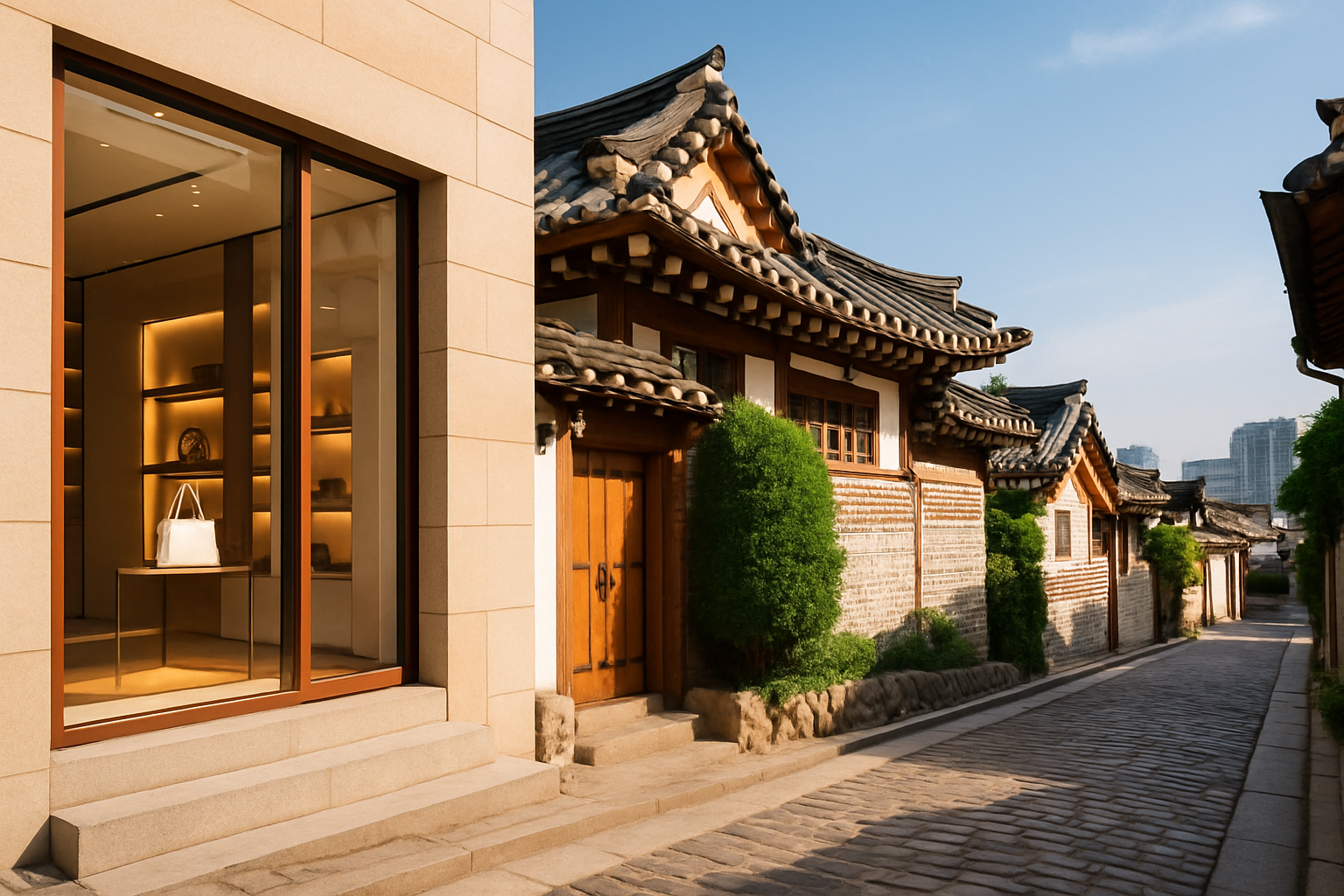
Seoul's Shopping Scene Is Shifting — And It's Heading North
If you've been following Seoul's retail landscape over the past few years, you already know about Seongsu-dong — the city's so-called "Brooklyn of Seoul," packed with pop-up stores, concept cafes, and no shortage of people holding their phones up to take that perfect shot. But here's the thing: some Seoulites are getting a little tired of it. And brands? They're taking notes.
Enter Bukchon. Nestled between Gyeongbokgung Palace and the famous hanok village near Anguk Station, this historic neighborhood has quietly been transforming into Seoul's next major retail destination. And the brands moving in aren't small — we're talking MLB, New Balance, Adidas, Tamburins, Aesop-level prestige, and now even Chinese toy giant Pop Mart, which is set to open a new location in the area next month.
From Tourist Spot to Brand Playground
So what's actually going on in Bukchon right now? According to industry reports, this year alone has seen a wave of flagship store openings from both Korean and international fashion labels. MLB and Malbon Golf set up shop earlier this year. Setter followed. Haircare brand Aromatica opened a themed experiential store centered around aromatherapy. Even KFC is joining the party with a pop-up store opening next month. Interior lifestyle platform Ohouse — think of it as Korea's answer to a curated home-living showroom — also chose Bukchon as the home for its first experiential space.
Some brands saw the potential here much earlier. Amorepacific's flagship skincare line Sulwhasoo has operated its "House of Sulwhasoo" in the neighborhood since 2021, blending traditional Korean aesthetics with a luxury beauty experience. Nonfiction, a Korean fragrance brand that's been riding the wave of global interest in K-beauty, planted its flag in Bukchon back in 2022 — setting up inside a former gallery space that still feels like one.
Then in 2024, Adidas opened a Bukchon flagship, and that seemed to open the floodgates. New Balance launched what it calls a "Bukchon Run Hub" — a community space where you can borrow running shoes and gear, and get guided along local running routes. It's not just a store; it's a lifestyle activation. Tamburins, the cult Korean beauty and lifestyle brand, also made its Bukchon presence known.
And the numbers back up the buzz. According to Korea Real Estate Board data, the vacancy rate in the Bukchon commercial district dropped to just 1.9% in the first quarter of this year, down from 4.4% the year prior. That's a dramatic tightening, and it signals that this isn't a passing trend.
The "Longform" Alternative to Seongsu's Quick Hits
What's really interesting is how the industry is framing Bukchon's appeal in contrast to Seongsu. If Seongsu is the shortform content of Seoul retail — fast, visual, Instagram-optimized — then Bukchon is the longform version. It's a place where brands can communicate their philosophy slowly, letting visitors stay longer, explore deeper, and actually connect with what the brand stands for.
Retail expert Nam Shin-gu, a director at Cushman and Wakefield Korea, put it bluntly: "Adidas and Tamburins in Bukchon are like what Dior was to Seongsu's rise." His point being — those who recognize a neighborhood's potential early enough to move in before rents and competition spike are the ones who win. And companies that missed that window in Seongsu are already moving faster this time around.
Bukchon's draw isn't just aesthetic nostalgia, either. The neighborhood encourages what the industry calls "stay-type consumption" rather than "purpose-driven shopping." You don't come to Bukchon to grab something and leave. You wander. You linger in a hanok courtyard. You try on shoes and get them customized with beads and patches at Adidas or MLB. The experience is the point — and that's exactly what brands are designing for.
Riding the Foreign Tourist Wave
There's another major factor at play here: international tourism. In the first quarter of this year, a record-breaking 4.76 million foreign tourists visited South Korea — the highest quarterly figure ever recorded. A significant chunk of those visitors are heading straight for the traditional neighborhoods around Gyeongbokgung and the Bukchon hanok village, which means foot traffic in the area is surging.
An industry insider put it this way: "As K-content continues to expand its global influence, demand isn't just for simple sightseeing anymore — people want to experience the full Korean lifestyle, from beauty to fashion to food." That's a shift from tourists who want to see Korea, to tourists who want to live it, even briefly. And brands are positioning Bukchon as the place to do exactly that.
Meanwhile in Myeongdong: Uniqlo Goes Big
While Bukchon is the story of a neighborhood on the rise, Seoul's more established shopping district of Myeongdong — long considered the city's top shopping and tourist corridor — is also seeing significant retail investment. Global fashion brand Uniqlo officially opened its largest flagship store in Korea on May 22, spanning three floors and nearly 3,255 square meters (roughly 1,000 pyeong in Korean measurement) right in the heart of Myeongdong.
The store covers the full Uniqlo "LifeWear" lineup — women's, men's, and kids and baby — and includes a few standout features worth mentioning. On the first floor, there's a UTme! customization zone, where shoppers can create personalized T-shirts and tote bags using stamps and sticker designs. For the Myeongdong location specifically, Uniqlo collaborated with local partners — including snack brand HBAF, the beloved Euljidabang cafe, and local illustrator Rimu — to create limited-edition designs that capture the look and feel of Myeongdong itself. It's a genuinely clever move for a brand that wants to connect with both domestic shoppers and foreign tourists looking for something a little more personal than a standard souvenir.
The store also runs a "Re.Uniqlo Studio" offering clothing repair and embroidery services — part of Uniqlo's global sustainability push. And before the grand opening, Uniqlo partnered with Korean environmental NGO the Environmental Foundation to run a plogging event (that's jogging combined with picking up litter, for those unfamiliar) around Myeongdong, with over 40 employees and volunteers participating.
K-Fashion on the World Stage
Zoom out even further, and there's a bigger story unfolding here. Korean fashion — not just K-beauty or K-pop merchandise, but actual Korean designer fashion — is gaining serious global traction.
The clearest signal came at this year's Met Gala, the annual Metropolitan Museum of Art fundraising event in New York that functions as the fashion industry's most high-profile gathering. Karina (Yoo Ji-min), a member of K-pop group aespa, arrived at the Carlyle Hotel in a Prada gown — but not just any Prada gown. The Italian luxury house specifically designed the look with a cape inspired by the hanbok, Korea's traditional dress. A global luxury brand using a K-pop star as the vehicle to debut a Korea-inspired design on fashion's biggest stage. That's a meaningful moment.
It's also worth noting that all four members of BLACKPINK were invited to this year's Met Gala — Jennie (Kim Jennie) representing Chanel, Jisoo (Kim Ji-soo) in Dior, Rosé (Park Chae-young) in Saint Laurent, and Lisa (Lalisa Manoban) in Louis Vuitton. That sweep of four members each holding ambassador roles at four of the world's top luxury houses is, frankly, remarkable.
American Vogue recently ran a piece on what it called the "superfan economy," noting that major fashion show venues are now filled with fans holding banners and balloons, waiting to catch a glimpse of their favorite idol-turned-brand-ambassador. The old model — where a designer and a magazine editor set the trend, and department store boutiques distributed it downward — has been upended. Now K-pop fandoms and social media move markets in real time.
Korean designer brands are benefiting directly. According to research firm Trend Research, Korea's independent designer fashion industry was valued at approximately 1.357 trillion Korean won (roughly one billion USD) in 2023, with consistent year-on-year growth. About four in ten Korean designer brands now have some form of international presence — reaching global customers not through traditional wholesale channels, but through social media virality and pop-up events.
The Korea Creative Content Agency (KOCCA) has noted it plans to strengthen support for Korean brands pursuing global expansion — helping cultivate what it calls brands with "sustainable sales competitiveness." Given where the market is heading, that investment looks well-timed.
The Bigger Picture
Whether it's a quiet hanok-lined street in Bukchon becoming the next brand pilgrimage site, a massive Uniqlo flagship celebrating Myeongdong's local culture, or a Prada gown nodding to the hanbok on the Met Gala red carpet — what we're really watching is Korean culture becoming a gravitational center for global fashion and retail. And the brands that understand that early, as the Bukchon story shows, tend to be the ones who benefit most.
This article is based on reports from Naver News, Slist, Naver News.