Not Your Typical Reunification Talk
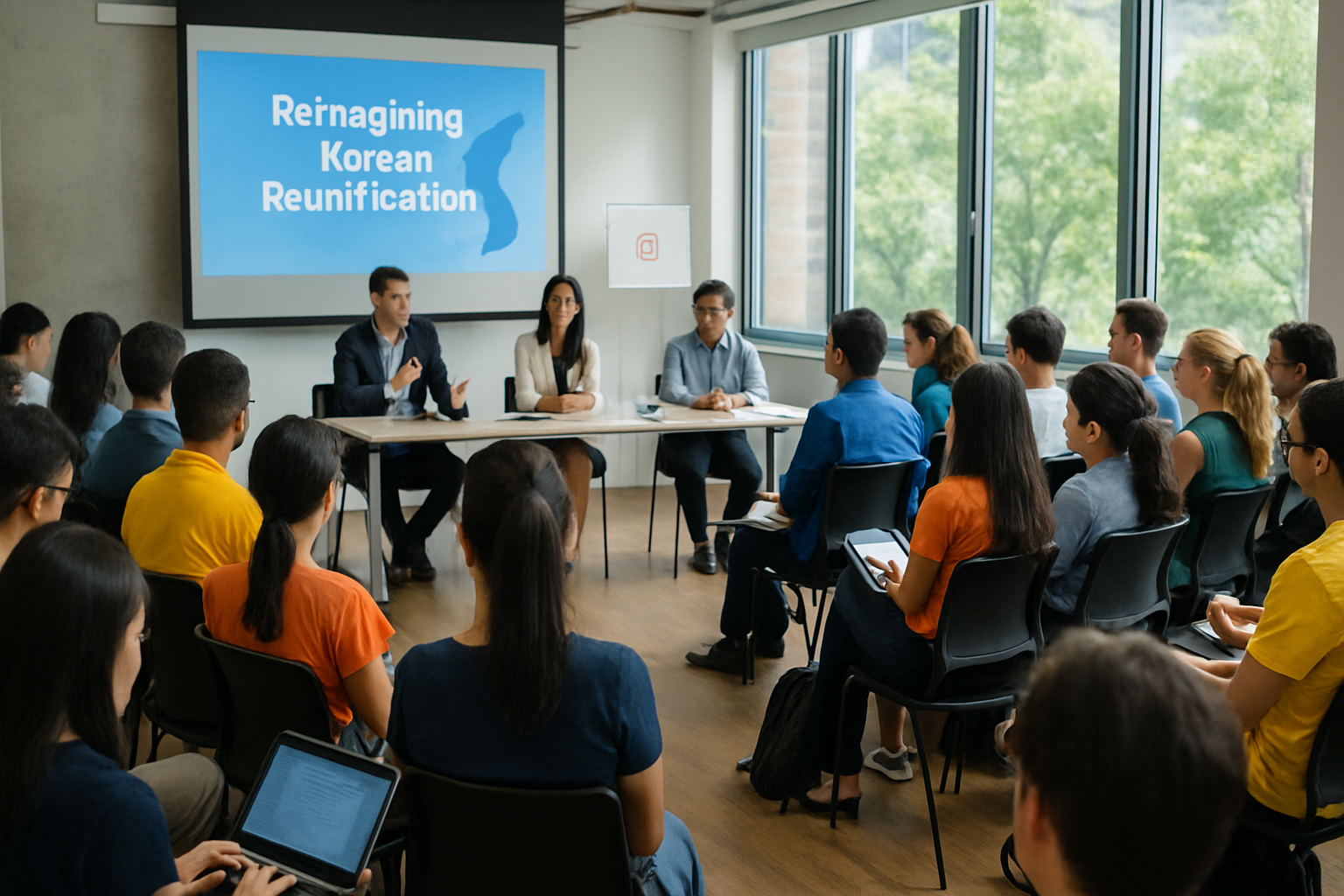
So here's the thing about Korean reunification debates — they tend to be dominated by politicians, academics, and diplomats trading abstract theories in conference rooms. But on August 12th, UN World Youth Day, something genuinely different happened in Seoul. Two hundred young people from 34 countries packed into the Seoul Startup Hub in Gongdeok to talk about peace on their own terms. And the results were, honestly, pretty remarkable.
The event was the 2026 One Korea Youth Forum, organized by the Global Peace Foundation Korea (GPF Korea) and — crucially — planned and run by youth organizations themselves from start to finish. The theme? "Startup for Peace." The idea was simple but powerful: stop treating reunification as a distant political problem and start treating it as something young people can actually imagine, design, and build.
Voices That Carry Real Weight
The forum opened with a panel discussion featuring four young speakers from very different backgrounds. What's really interesting here is who was in the room. This wasn't a homogeneous crowd of South Korean university students. The participants included South Koreans, North Korean defectors, Goryeo-saram (ethnic Koreans whose ancestors were deported to Central Asia during the Soviet era and who now live scattered across countries like Kazakhstan and Uzbekistan), and members of the Korean diaspora from around the world.
One of the most striking voices on the panel was Lee Na-young, a team leader who was born in Cheongjin, North Hamgyong Province — in North Korea. She spoke about the deeply personal cost of division, describing the reality that for North Korean defectors, even making contact with family members left behind can be a life-or-death risk.
"When separated families cannot reconnect or share everyday life, true peace simply does not exist. The right to family is the smallest unit of peace — and right now, for many of us, it is out of reach."
That kind of testimony doesn't come from a policy paper. It comes from lived experience, and it hit differently in a room full of young people who had traveled from across the globe to be there.
Redefining Identity as a Bridge, Not a Burden
Also on the panel was Park Yeon-hwa, a fourth-generation Goryeo-saram and chairperson of a youth organization. Her story is the kind that makes you rethink what "Korean identity" even means. Her family has lived outside Korea for generations, navigating multiple languages, cultures, and national borders.
Rather than describing that experience as confusing or painful, she reframed it entirely.
"Identity is not about choosing one side. It is a channel that connects different worlds. Young people must become the ones who transform stereotypes into understanding — and in doing so, build lasting peace across the division."
That reframing — from identity as burden to identity as bridge — seemed to resonate deeply with an audience that itself represented dozens of different national and cultural backgrounds.
The Keynote: Give Young People the Vision, and They'll Run With It
The keynote address came from Yu Nam-sik, co-chair of the US-based Korean Reunification Solidarity. His message was straightforward and optimistic: young people respond to hope, not cynicism, and reunification needs to be framed as something they can actually own.
"Young people react more strongly to hope than to cynicism. Give them a vision they can understand, believe in, and lead — and they will organize, create, and act. Korean reunification must not be something they see as distant or impossible. It must become a future they imagine and build themselves."
It's a point worth sitting with. For many young South Koreans, reunification has historically polled as a low priority — something for older generations to argue about. Events like this seem designed to change that narrative by making the conversation more personal, more creative, and more global.
From Talk to Action: The Peace Innovation Challenge
The afternoon session moved beyond discussion into something more hands-on. Participants split into 20 teams to compete in the "Peace Innovation Challenge," pitching real project ideas for peace and reunification on the Korean Peninsula — all grounded in the United Nations Sustainable Development Goals (SDGs).
The proposals that came out of the room were genuinely creative. Some highlights included:
- Designating the DMZ (the Demilitarized Zone that has divided North and South Korea since the 1953 armistice) as a national park and pursuing UNESCO World Heritage status for the site
- Developing an AI-powered climate disaster response system for the Korean Peninsula
- Cross-border environmental cooperation projects connecting young people from both sides of the divide
What stands out here is the shift in framing. Traditional reunification discourse has centered on politics, military security, and economics. This generation is connecting the Korea question to climate change, artificial intelligence, and sustainability — the issues they care about most. That's not a detour from the main conversation. For these young people, it is the main conversation.
A New Network Is Born
The forum closed with a significant milestone: the official launch of the "One Korea Youth Solidarity," an international cooperation network dedicated to peace and reunification on the Korean Peninsula. Representatives from youth organizations across the 34 participating countries signed and read aloud a joint declaration together.
It was a moment that organizers and participants alike framed not as the end of a conference, but as the beginning of something ongoing. The goal, as the forum's own framing made clear, is to move reunification discourse out of the realm of declarations and slogans and into the realm of projects, networks, and real-world action.
Why This Matters Beyond Korea
For global audiences, it's worth understanding just how loaded the topic of Korean reunification is. The Korean Peninsula has been divided since 1945, and the Korean War (1950–1953) ended not with a peace treaty but with an armistice — meaning the two Koreas are technically still at war. Decades of diplomacy, summits, and negotiations have produced little lasting change.
Against that backdrop, a forum where a North Korean defector, a fourth-generation Central Asian Korean, and young people from 32 other countries sit together to brainstorm AI-powered climate solutions for a unified peninsula is, quietly, a pretty radical act. Whether it translates into lasting political momentum remains to be seen. But as a signal of how the next generation wants to engage with one of the world's most entrenched divisions, it's hard to ignore.
This article is based on reports from Kdfnews, Chosun Ilbo, Naver News.