Three Stories Reshaping the Korean Economic Landscape
There is a lot happening in the world of Korean finance and policy right now, and this week three stories in particular are worth putting side by side, because together they paint a pretty revealing picture of the pressures — global and domestic — that the Korean economy is navigating all at once. Let's break them down one by one.
A New Sheriff at the Fed — and Korea Is Watching Closely
So here's the thing about the U.S. Federal Reserve: it is technically America's central bank, but its decisions ripple out across every corner of the global economy. And as of this week, it has a new leader. Kevin Warsh officially took his oath of office as Fed Chair, was sworn in as a member of the Board of Governors, and was elected Chair of the Federal Open Market Committee — the body that actually sets interest rates. Jerome Powell, who held the role since 2018, served as acting chair right up until the handover.
Now, who is Kevin Warsh? He previously served as a Fed Governor during the 2000s and was in the room during the 2008 global financial crisis. What's notable — and what markets are paying close attention to — is that back in 2011, he publicly broke with the Fed over its second round of quantitative easing, essentially arguing the stimulus was going too far. That is not the profile of a straightforward dove. He is not someone markets expect to simply cave to political pressure for rate cuts.
In his first public remarks as chair, Warsh emphasized price stability and maximum employment as the Fed's core missions, while also stressing independence and a reform-minded approach to running the institution. That sends two signals simultaneously: one, he is not going to be pushed around by President Trump's well-documented desire for lower interest rates; and two, he plans to run things differently from the Powell era.
"The Fed's independence is not just an institutional tradition — it is the foundation of monetary credibility."
What's really interesting is how this plays out for Korea specifically. The Korean won's exchange rate, foreign capital flows, household debt conditions, and even the real estate market all sit in the shadow of U.S. monetary policy. If Warsh keeps rates elevated — which he may, especially if inflation proves stubborn — the dollar stays strong. A strong dollar means a weaker won, which sounds like good news for Korean exporters on the surface, but it also drives up the cost of energy and raw material imports, and can push inflation higher domestically. On top of that, a more attractive dollar-denominated return in the U.S. makes it easier for foreign investors to pull money out of Korean markets.
Analysts are urging Korea to do three things in response: strengthen its foreign exchange buffers, build out its industrial competitiveness in areas like AI, semiconductors, batteries, and shipbuilding rather than just reacting to whatever the Fed does, and protect the independence and credibility of the Bank of Korea. That last point matters more than people often realize — monetary policy only works when markets trust the institution making it.
The U.S.-China Biotech Cold War — and the Opportunity It Opens for Korea
Here is a story that has not gotten enough attention outside of industry circles, but it really should. In the United States, there is a growing legislative push to restrict American capital from flowing into Chinese biotechnology companies — and if it succeeds, it could meaningfully shift the global pharma landscape in Korea's favor.
Earlier this week, John Moolenaar, the Republican congressman who chairs the House Select Committee on China, sent a letter to Treasury Secretary Scott Bessent urging that biotech be included in the list of prohibited sectors under the COINS Act — the Comprehensive Outbound Investment National Security Act. This is a law designed to prevent U.S. money from fueling technological advancement in adversarial nations, and the Trump administration is currently drafting its implementing regulations.
Moolenaar's concern is concrete and data-driven. Last year, licensing deals between multinational pharmaceutical companies and Chinese biotech firms totaled roughly 136 billion dollars. Among all major drug licensing deals worth more than 50 million dollars globally in 2024, a remarkable 48 percent involved a Chinese company on one side of the table. For context, in 2020, that figure was zero percent. China's rise in pharmaceutical innovation has been that fast.
The catalyst for the letter appears to be a specific deal: Bristol Myers Squibb recently signed a 15 billion dollar agreement with Chinese drugmaker Hengrui Pharmaceuticals, including a transfer of intellectual property to China. For those in Washington focused on strategic competition, that is exactly the kind of deal they want to stop.
Moolenaar wrote that "China has pursued a deliberate, state-directed strategy to dominate global biotechnology," and that American capital flowing through licensing deals, joint ventures, and equity investments is "fueling China's biotech strategy."
The specific areas he wants scrutinized include pharmaceutical intellectual property, drug development platforms, clinical research capabilities, and biopharmaceutical manufacturing know-how.
So where does Korea fit in? South Korean pharmaceutical and biotech companies exported a record-breaking 20 trillion won worth of drug technology licenses last year — a genuine milestone for the industry. But compared to what Chinese firms are pulling in, it is still a fraction. The question is whether tightening U.S. rules on Chinese biotech partnerships creates space for Korean companies to step into that gap.
Industry analysts think the answer is yes. Heo Hye-min, a researcher at Kiwoom Securities, pointed out that Korean biotech has something Chinese firms currently lack in the eyes of global pharma: a long track record of reliable partnerships and high data credibility. Those are exactly the qualities that big pharmaceutical companies — known in the industry as "Big Pharma" — look for when they are deciding who to license a drug from.
Samsung's Low-Interest Housing Loans Are Stirring Up a Fairness Debate
Back home in Korea, a different kind of controversy is brewing — one that sits right at the intersection of corporate welfare, housing policy, and economic inequality.
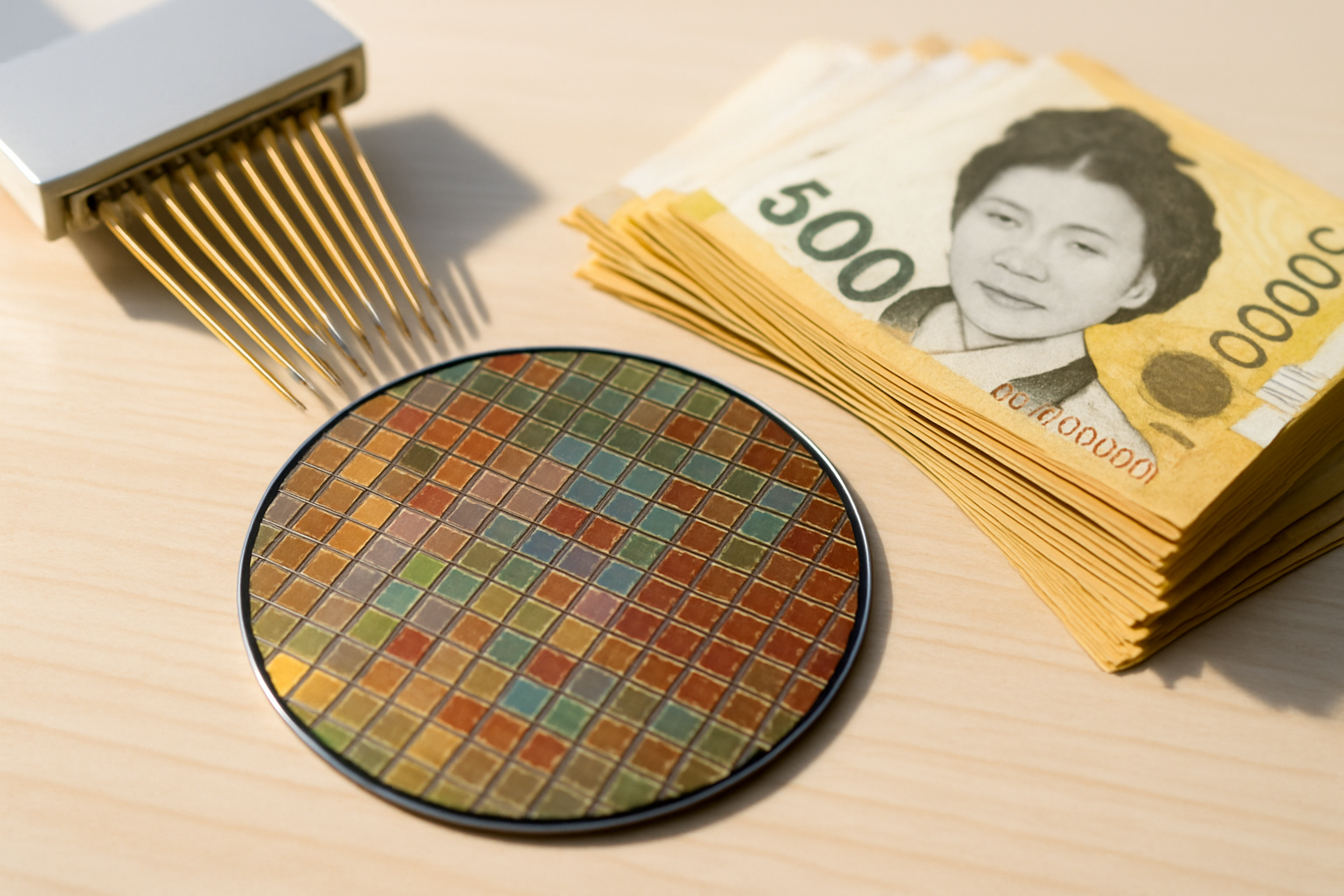
Samsung Electronics and its labor union have reportedly reached a tentative wage and benefits agreement that includes, among other things, a new in-house housing loan program for employees. Under the proposed terms, Samsung workers without a home of their own could borrow up to 500 million won — roughly 360,000 U.S. dollars — to purchase a house, or up to 300 million won for a rental deposit, all at an annual interest rate of just 1.5 percent, repayable over up to ten years. To put that in context, commercial bank mortgage rates in Korea currently sit significantly higher than that.
The proposal still needs to pass a member vote before it becomes official, but it has already set off a fierce public debate.
Here is why. President Lee Jae-myung has been vocal — repeatedly and forcefully — about cracking down on what he has called "ruinous real estate speculation." The government has been tightening mortgage lending rules, applying strict debt-to-income caps known as DSR (Debt Service Ratio) limits and loan-to-value restrictions to rein in household debt and cool the housing market. For the average Korean worker trying to buy a home in Seoul, where apartment prices have risen for 66 consecutive weeks as of mid-May, these rules have made homeownership feel increasingly out of reach.
The controversy is not just about Samsung. SK Hynix reportedly offers loans of up to 100 million won at 1.5 percent. SK Telecom offers a similar program at 1.2 percent. Hyundai Motor reportedly offers up to 100 million won at around 2 percent. And crypto exchange operator Dunamu apparently raised its employee housing loan ceiling from 300 million to 500 million won in July 2025 — as a zero-interest loan — right around the time the government was tightening mortgage restrictions for everyone else.
What makes the critique sharper is a structural quirk: corporate welfare loans of this kind are typically funded through internal employee welfare funds, which means they fall outside the DSR and LTV calculations that govern bank lending. In theory, a Samsung employee could take the corporate loan and still access the full amount of bank financing they are entitled to on top of it.
Perhaps most pointed is the criticism aimed at public institutions. Several major Korean public agencies — including the Bank of Korea, the Korea Land and Housing Corporation (LH), the Korea Housing Finance Corporation, and the Korea Development Bank — are also reported to operate similar in-house low-interest housing loan programs for their own staff. These are the very institutions responsible for enforcing household debt rules, managing housing finance, and promoting housing stability for the general public. The optics of setting lending restrictions for ordinary citizens while quietly offering subsidized housing capital to staff on the inside are, to put it mildly, difficult to defend.
Commentators are careful to note that Samsung's loan program is not necessarily illegal, and helping employees afford stable housing is not inherently wrong. But the fairness question is real. Small business owners, freelancers, and workers at smaller companies — people who pay the same taxes and compete in the same housing market — have no access to any equivalent benefit. They face the full weight of tightening lending rules with none of the workarounds.
Critics are calling on the government not to punish large employers for offering benefits, but to close the gap by expanding access to low-interest policy housing loans for small business workers and first-time buyers who currently have no safety net. As one editorial framed it, drawing on the Confucian philosopher Mencius: without stable livelihoods, stable minds cannot be expected. The same applies to housing policy.
This article is based on reports from Seoul Economic Daily, Ajunews, Cfnews.