Three Stories, One Bigger Picture
Every now and then, a handful of seemingly unrelated local news stories land at the same time and, when you put them side by side, they tell you something surprisingly coherent about where Korea is headed. This week, we have a small mountain county sending every single one of its middle and high schoolers abroad, a major industrial city retiring a beloved festival in favor of something older and deeper, and a linguistics professor at one of Korea's top science universities making a compelling case about why a cup of iced coffee at a job interview might actually be a civilizational event. Let's get into it.
A Rural County With a Big, Bold Bet on Its Kids
So here's the thing about Hwacheon County — it's a small, mountainous region in Gangwon Province, in the northeastern part of South Korea. It's the kind of place that most international readers probably haven't heard of, but it punches well above its weight when it comes to community initiatives. And starting next year, it's doing something that even some of South Korea's wealthiest urban districts haven't managed: sending every single second-year middle school student and every first-year high school student on an overseas program. Not a select few. Everyone.
Previously, the county ran language immersion trips and backpacking study tours abroad, but spots were limited and competitive. If you didn't make the cut, you simply missed out. That changes in 2027. County officials announced on July 6th that the selection process is being scrapped entirely. Every eligible student, regardless of their current language ability or academic standing, will get a chance to experience life outside Korea's borders.
"Even a student with limited foreign language skills can be powerfully motivated by an overseas experience. What matters is giving them the opportunity," said Kim Se-hun, the county's chief administrator. "We will spare no effort in supporting Hwacheon's young students to experience a wider world and imagine their own futures."
What's really interesting is the philosophy behind this. It's not just about language skills or padding a college resume. The county is making a deliberate argument that exposure itself — to different cultures, environments, and ways of living — is intrinsically valuable, especially for kids growing up in a rural setting where those opportunities don't just fall into your lap.
Orchestra Edition: Hwacheon's Young Musicians Head to Germany
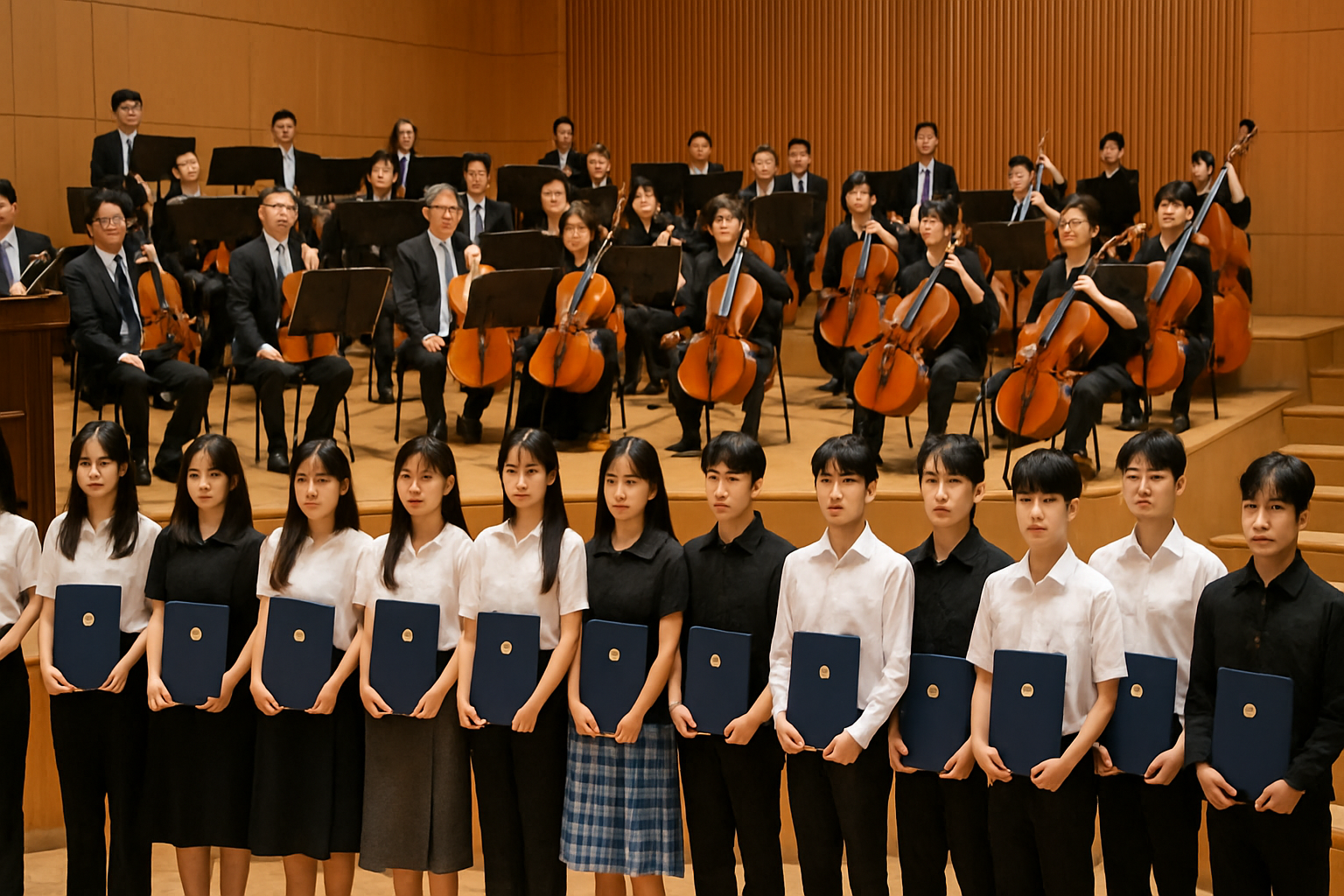
And the global ambitions don't stop at the classroom. The Hwacheon Youth Symphony Orchestra is heading to Germany from July 15th to 22nd for a six-night, eight-day cultural exchange tour. Forty-four participants, including 36 young musicians and their instructors, will visit the Ravensburg Municipal Music School — a well-regarded music education institution in southern Germany — for an exchange program with youth ensembles from multiple countries.
On July 17th, the orchestra will perform a joint concert at the Evangelische Stadtkirche church, with a setlist that mixes K-pop arrangements with "Arirang Fantasy" — a classical orchestral reimagining of Korea's most iconic folk song — alongside major Western classical works. It's a genuinely lovely image: a youth orchestra from a small Korean mountain county performing for a German audience, bridging two very different musical traditions in a centuries-old church.
Ulsan Says Goodbye to Its Industrial Festival — For Good This Time
Meanwhile, about 500 kilometers to the south, the city of Ulsan is wrapping up a chapter in its civic identity. The Ulsan Industrial Festival, which was dramatically revived in 2023 after a 35-year hiatus, is holding its final edition this year. The four-day event runs from July 8th to 11th at Taehwagang National Garden's Namgu riverside area — a scenic stretch along the Taehwa River that serves as the city's green lung.
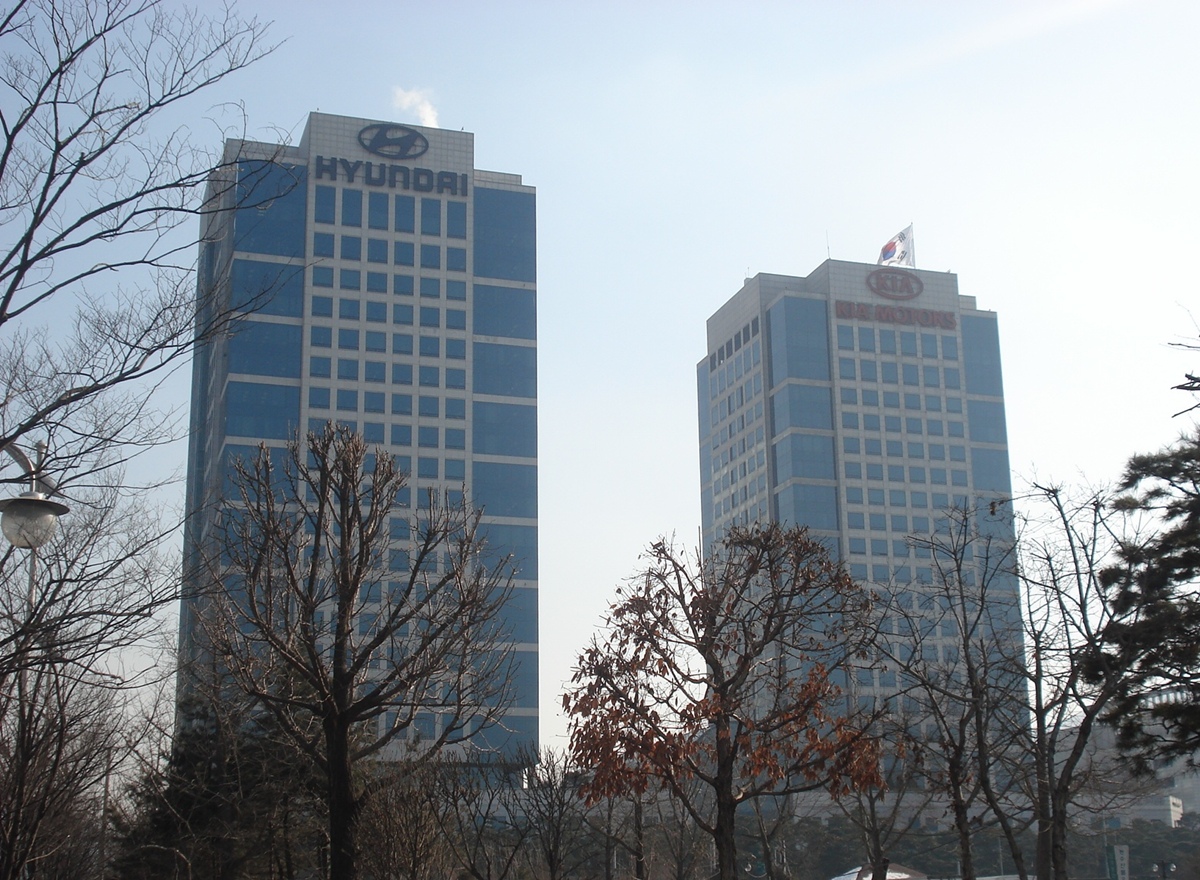
For context: Ulsan is essentially the industrial heartbeat of South Korea. It's home to the world's largest shipbuilding complex, a massive Hyundai automotive hub, and one of the biggest petrochemical clusters in Asia. The Industrial Festival was always a celebration of that identity — complete with street parades and large-scale civic spectacle. But Ulsan's new mayor, Kim Sang-wook, has been clear since before he even took office that he wants to move on.
His plan is to revive the Cheoyong Cultural Festival, a far older tradition rooted in Ulsan's ancient heritage. Cheoyong is a figure from the Silla Dynasty era (roughly 7th to 10th century) — a mythological character associated with warding off disease and evil spirits, who has become a symbol of Ulsan's pre-industrial cultural identity. The city intends to consult citizens in November on the exact name and format of its new flagship festival, with the transition beginning in 2027.
This Year's Festival: A Bridge Between Two Eras
So what does the final Ulsan Industrial Festival actually look like? It's been deliberately redesigned as a transitional event. Gone are the street parades and the "9988 Ulsan! March of Youth" procession that defined previous editions. In their place: community-centered programming featuring local artists, university student performances, a K-pop stage, and a series of traditional Korean cultural performances.
The closing ceremony in particular leans hard into heritage — featuring namsadangn-ori (a traditional traveling performance art), samulnori (a percussion ensemble genre),줄타기 (tightrope walking), and ganggangsullae (a traditional circle dance), all listed as significant Korean intangible cultural assets. The festival's theme performance incorporates imagery from Bangudae, a UNESCO World Heritage rock art site located in Ulsan, alongside tributes to local historical figures.
The opening night on July 8th features performances by well-known Korean entertainers including Cha Ji-yeon, Baek In-tae, Park Hye-kyung, the Woongsan Band, Soran, and rock band OneWe, capped off with a 1,000-drone light show and fireworks. It's a grand send-off for a festival that, love it or leave it, represented a specific chapter in how Ulsan understood itself.
The Iced Coffee Question: Who Gets to Decide What's Professional?
And then there's the essay that's been making the rounds in Korean intellectual circles this week, written by Choi Jin-suk, a professor of linguistic anthropology at UNIST — that's the Ulsan National Institute of Science and Technology, one of Korea's elite research universities. Her piece uses a surprisingly small flashpoint to make a genuinely large argument.
The flashpoint: a debate that erupted in the United States after a job applicant walked into an interview holding an iced coffee. Older generations were appalled. Younger people shrugged. What's the big deal?
Professor Choi frames this through the lens of sociologist Erving Goffman's concept of "front stage" and "back stage" selves — the idea that in public, formal spaces, we perform a curated version of ourselves that conforms to the social norms of that moment. A job interview, she argues, is perhaps the most extreme version of that front-stage performance. But here's the catch: the script for that performance is not fixed.
Social norms are not an unchanging sacred law. When a generation's technology, industrial structure, and sensibilities shift, the lighting on the stage and the audience's expectations must shift with them.
She offers several compelling examples from Korean history. In the early 1990s, the legendary Korean group Seo Taiji and the Boys — widely credited with launching the modern K-pop era — were actually banned from broadcast television because network censors deemed their hip-hop outfits and reggae-inspired hairstyles "improper attire and attitude." They were told to come back in neat, conventional clothing. Today, the aesthetic descendants of exactly that style dominate global pop culture.
She also points to a striking recent development: starting in October 2026, South Korea's Ministry of Personnel Management has officially banned formal suits and dress shoes from the national civil service interview exam, encouraging clean casual wear instead. The uniform of professional seriousness, it turns out, has quietly become a symbol of rigidity rather than respect.
Her conclusion is both generous and pointed: before older generations rush to morally condemn what young people are doing, it's worth remembering that yesterday's deviation has a tendency to become tomorrow's standard. The iced coffee in the interview room might just be the opening note of a new social contract being written in real time.
The Common Thread
So what ties all three stories together? Probably this: Korea — in its cities and its counties, in its festivals and its classrooms and its op-ed pages — is visibly in the middle of renegotiating what it values and how it expresses those values. Hwacheon is betting on openness and experience over selection and competition. Ulsan is trading industrial pride for something older and more rooted. And Professor Choi is asking everyone to hold their judgments loosely, because the script, as she puts it, is always subject to revision.
Not a bad week for a country often described as being in a hurry.